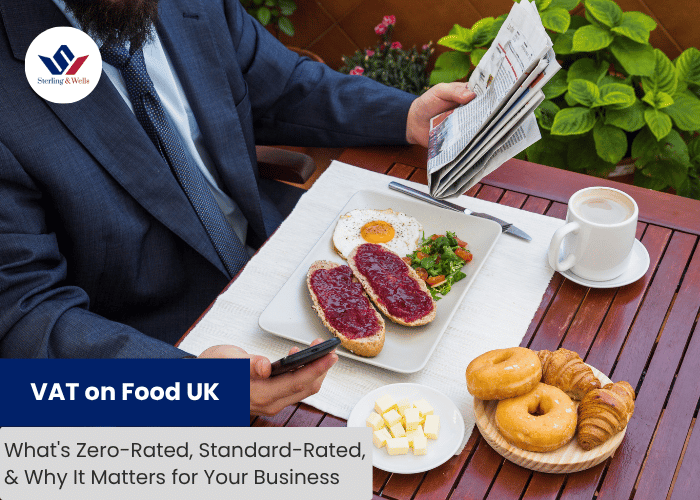
VAT on food is one of the more deceptively complex areas of UK tax law. Most everyday groceries are zero-rated for VAT, but a wide range of everyday items, including hot takeaway food, confectionery, drinks served in a café, and food eaten on the premises, are taxed at the standard rate of 20%. For any business that sells food, correctly classifying products is essential for accurate pricing, sound VAT returns, and avoiding penalties from HMRC.
This guide sets out the core rules, the key exceptions, and what they mean in practice for your business.
At a Glance
|
|
Usually Zero-Rated (0%)
|
Usually Standard-Rated (20%)
|
|---|---|---|
|
Groceries
|
Bread, fruit, vegetables, meat, fish, milk, plain cakes and biscuits
|
Confectionery, crisps, ice cream, soft drinks, alcohol
|
|
Drinks
|
Tea and coffee bought as ingredients
|
Tea and coffee served to a customer
|
|
Takeaway food
|
Cold food sold to take away
|
Hot food, regardless of how it is sold
|
|
Food eaten on premises
|
N/A
|
Generally standard-rated, hot or cold (commercial settings)
|
The General Rule: Most VAT on Food Is Zero-Rated
Under Schedule 8, Group 1 of the VAT Act 1994, food of a kind used for human consumption is generally zero-rated. HMRC’s own guidance confirms that most food intended for human consumption falls under this treatment.
Typical zero-rated items include:
- Bread and most bakery products
- Fresh fruit and vegetables
- Meat and fish
- Milk and milk alternatives (such as oat or soya milk)
- Loose tea and coffee
- Most cakes and plain biscuits
It is worth clarifying an important distinction: zero-rated is not the same as VAT-exempt. Zero-rated goods remain within the VAT system, taxed at 0%, which means a business can still reclaim the VAT paid on its own ingredients and supplies. Exempt supplies sit outside the VAT system entirely, and input VAT on related costs generally cannot be recovered. For a food business, this distinction directly impacts cash flow.
What Is Always Standard-Rated
Certain categories of food and drink are standard-rated at 20% regardless of how or where they are sold:
- Confectionery, including sweets and chocolate-covered biscuits
- Crisps and savory snacks, including roasted or salted nuts
- Ice cream and similar frozen products
- Soft drinks, bottled water, and alcoholic drinks (taxed as “other beverages” under the relevant legislation)
- Hot drinks served to a customer, such as tea and coffee
The treatment of hot drinks served hot is a common point of confusion: ground coffee or loose tea purchased as an ingredient is zero-rated, but the same drink prepared and served to a customer is standard-rated, since HMRC distinguishes between a raw ingredient and a prepared drink.
The Jaffa Cake Case: Where the Boundary Lines Thin
UK VAT on food law contains several long-litigated boundary cases, the most well-known of which is the 1991 tribunal concerning Jaffa Cakes. HMRC’s position was that Jaffa Cakes should be classified as chocolate-covered biscuits and therefore standard-rated. McVitie’s argued they were cakes, and therefore zero-rated. The tribunal found in McVitie’s favor, on the basis that a stale Jaffa Cake hardens, consistent with cake behavior, whereas a stale biscuit softens.
The case illustrates a broader principle that remains relevant today: classification can turn on precise physical characteristics, such as texture, composition, size, and how a product is marketed, rather than on general category alone. Businesses with products near these boundaries should assess them directly against HMRC’s food VAT notice rather than relying on assumption.
The Hot Food Rule
One of the most significant distinctions in VAT on food, and one of the most frequent sources of error, is temperature. Food supplied hot for consumption hot, or kept hot after preparation, is generally standard-rated at 20%, even where the same item sold cold would be zero-rated. This applies whether the food is sold to eat in or to take away.
For example:
- A cold sausage roll taken from a shelf: zero-rated
- The same sausage roll kept warm under a heat lamp: standard-rated
- A hot pizza collected as takeaway: standard-rated
- A cold, pre-packaged sandwich sold to take away: zero-rated
For bakeries, takeaways, and sandwich shops in particular, correctly identifying whether an item is hot at the point of sale is fundamental to accurate till coding.
The Catering Rule: Where Food Is Consumed
In addition to temperature, the location of consumption also determines VAT treatment. In commercial catering establishments, any food consumed on the premises, whether inside the shop, at outdoor seating, or in shared seating such as a food court, is treated by HMRC as supplied “in the course of catering,” and catering is generally standard-rated at 20%, irrespective of temperature. Separate rules apply to certain supplies in schools, hospitals, and similar establishments, which are outside the scope of this guide.
This is the underlying reason customers are typically asked whether they are eating in or taking away: the answer determines the VAT rate applied. A cold sandwich sold for takeaway is zero-rated; the same sandwich consumed at a table on the premises is standard-rated.
A Temporary Change for 2026
In addition to temperature, the location of consumption also determines VAT treatment. In commercial catering establishments, any food consumed on the premises, whether inside the shop, at outdoor seating, or in shared seating such as a food court, is treated by HMRC as supplied “in the course of catering,” and catering is generally standard-rated at 20%, irrespective of temperature. Separate rules apply to certain supplies in schools, hospitals, and similar establishments, which are outside the scope of this guide.
This is the underlying reason customers are typically asked whether they are eating in or taking away: the answer determines the VAT rate applied. A cold sandwich sold for takeaway is zero-rated; the same sandwich consumed at a table on the premises is standard-rated.
Mixed Supplies: Meal Deals
Meal deals present a recurring compliance challenge. A bundle combining a zero-rated item, such as a sandwich, with standard-rated items, such as crisps and a soft drink, will often need to be apportioned between the individual components. However, the correct treatment depends on whether HMRC regards the package as a mixed supply, with VAT calculated separately on each component based on its value, or as a single composite supply taxed at one rate. Incorrect treatment of these bundles is a common source of HMRC penalties for food retailers.
Illustrative Example: A Cafe
Consider a cafe selling coffee, sandwiches, and pastries, with a small number of tables:
- A customer purchases a takeaway coffee: standard-rated (served hot drink)
- A customer purchases a cold, pre-packed sandwich to take away: zero-rated
- A customer sits at a table and eats the same sandwich on the premises: standard-rated (consumed in the course of catering)
- A customer purchases a plain croissant to take away: zero-rated
- A customer purchases a chocolate-covered biscuit to take away: standard-rated (chocolate-covered)
A single till and five distinct VAT outcomes underline the importance of a properly configured point-of-sale system rather than relying on staff judgment at the point of sale.
Why VAT on Food Matters for Your Business
• Pricing Accuracy
Misclassifying a standard-rated item as zero-rated results in either an absorbed 20% cost or an under-collection of VAT owed to HMRC.
• Cash Flow
Zero-rated goods allow input VAT to be reclaimed on related costs, offering a meaningful cash-flow advantage over exempt supplies, where this is generally not possible.
• Compliance Risk
Hot food, eat-in versus takeaway, and confectionery classification are among the most frequently scrutinized areas by HMRC, and a common source of assessments and penalties.
• VAT Registration
Total taxable turnover, including zero-rated sales, counts towards the VAT registration threshold of £90,000 in any rolling 12-month period. A business that predominantly sells zero-rated goods may still be required to register.
• Systems & Processes
Businesses selling a mix of hot and cold, eat-in and takeaway, or zero-rated and standard-rated items require point-of-sale systems configured to correctly code each item, including provisions for temporary rate changes, such as the 2026 children’s meals reduction.
Conclusion
While “most food is zero-rated” remains a useful starting point, the exceptions typically determine the VAT outcome for a working food business: temperature, point of consumption, and product category. Businesses are advised to assess each product line individually against HMRC’s published guidance rather than relying on general assumptions, and to review classification whenever preparation, packaging, or method of sale changes.
Frequently Asked Questions
No. Bread is zero-rated.
Yes, at 20%, as it is a prepared drink served to the customer rather than a raw ingredient.
Not if sold to take away. If consumed on the premises, it is standard-rated.
Generally, no. Most cakes are zero-rated, including chocolate-covered varieties, as established in the Jaffa Cake case. Chocolate-covered biscuits, however, are standard-rated.
Potentially, yes. The VAT registration threshold is based on total taxable turnover, including zero-rated sales, not solely on sales where VAT is actually charged. A business exceeding £90,000 in any rolling 12-month period must register.
