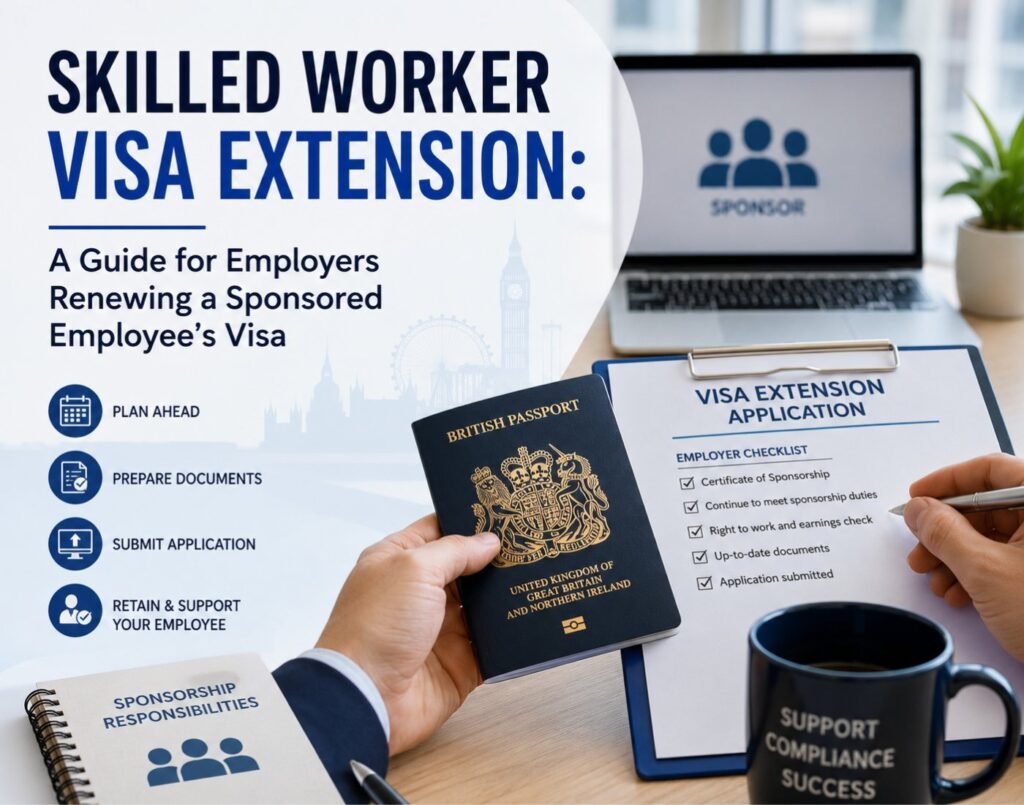
If one of your employees is on a Skilled Worker visa and that visa is running out, the responsibility for starting the renewal process sits with you as the employer, not with the employee. This surprises many businesses. The employee is the one making the visa application, so surely, they are in charge? Not quite. Before your employee can apply for a Skilled Worker visa extension, you must issue them something called a Certificate of Sponsorship. Without it, they cannot apply at all.
A Certificate of Sponsorship, or CoS for short, is an electronic reference number that tells the UK government who the employee is, what job they do, and what they are paid. It is not a paper certificate. You generate and assign it through an online government portal called the Sponsor Management System. Think of it as your formal endorsement that this person should be allowed to keep working for you under the Skilled Worker route.
This guide explains what you need to do as an employer when a sponsored employee’s visa is coming up for renewal: when to start, what the pay must be, how to issue the Certificate of Sponsorship, what happens to the employee’s right to carry on working while the application is being decided, and what you are legally required to report to the Home Office along the way.
If you are looking for guidance on what the employee themselves needs to do, such as booking a biometric appointment or paying the application fee, this guide touches on those only where they create a direct-action point for you as an employer.
KeyTakeaways
-
A Skilled Worker visa extension starts with you. The employee cannot apply until you have issued a Certificate of Sponsorship (a reference number that confirms the job offer and salary).
-
Start the process at least four months before the visa runs out. Requesting more Certificate of Sponsorship allowances from the Home Office can take up to 18 weeks.
-
When you issue the Certificate of Sponsorship for an extension, the salary must meet the current rules on that date, not the rules that applied when the employee was first sponsored.
-
From 22 July 2025, the minimum salary for most extensions is the higher of £ 41,700 per year or the 'going rate' for the type of job (the occupation-specific floor set by the Home Office). Both figures must be checked.
-
An employee who applies before their visa runs out is protected by something called Section 3C leave. This means they can carry on working lawfully while the Home Office makes its decision, even after the visa expiry date passes.
-
Once the visa expiry date passes and the application is pending, the normal online right-to-work check stops working. You must use a different government service which is the Employer Checking Service, to confirm the employee can still work.
-
If the application is not submitted before the visa runs out, even by one day, the employee loses their right to work immediately, and you could face a fine.
Where Most Employers Go Wrong and Why
Most employers think of a visa extension as something the employee handles. You carry on as normal, the employee sorts their paperwork, and life continues. In reality, the three most common reasons a Skilled Worker visa extension fails are all things the employer could have prevented.
Getting the salary wrong
When someone first joins your business on a Skilled Worker visa, the Home Office sets the minimum salary for that role based on the rules at that time. Those rules change. Every year or two the government reviews minimum pay levels by job type, and those levels can go up. If your employee has been on the same salary for two or three years, there is a real chance that salary no longer meets the current minimum.
Here is what goes wrong: the employer checks the general minimum (£ 41,700 from July 2025), sees the salary is above it, and issues the Certificate of Sponsorship. The application is then refused because there is a second minimum they did not check: the going rate for that specific type of job. For some roles, this job-specific minimum is significantly higher than £ 41,700. Both numbers must be met, and only the higher one counts.
Running out of Certificate of Sponsorship allowances
As a licensed sponsor (a business approved by the Home Office to hire overseas workers), you are given an annual allowance of Certificates of Sponsorship. Think of it like a budget of reference numbers. If you have used up your allowance and need more, you have to apply to the Home Office for extra ones. That process can take up to 18 weeks. An employer who discovers the allowance is empty with only six weeks to go before an employee’s visa expires cannot fix the problem in time.
Starting too late
Employees can apply for skilled worker visa extension up to three months before the visa runs out. But that three-month window is only available once you have issued the Certificate of Sponsorship. If you issue it with only five weeks to go, the employee has five weeks. If anything delays the application like a document that is hard to get hold of, a technical problem with the online system, or a busy period at the visa processing centre, the window closes. An application submitted even one day after the visa expires is treated as a new application from outside the rules, with serious consequences.
All three of these problems are preventable. All three require you to act, not the employee. The rest of this guide takes you through each step in the order you need to handle it.
When Should You Start the Skilled Worker Visa Extension Process?
Start four months before the visa expiry date. That might feel early, but it is the minimum you need to deal with a Certificate of Sponsorship allowance problem if one comes up. Here is what needs to happen in each stage.
|
When
|
What to do
|
Detail
|
|---|---|---|
|
Four months before
|
Check your Certificate of Sponsorship allowance
|
Log in to the Sponsor Management System (the Home Office's online portal for employers who sponsor overseas workers) and check how many Certificates of Sponsorship you have left in your annual allowance. If you do not have enough, request more from the Home Office immediately. Allow up to 18 weeks for this.
|
|
Three months before
|
Review the salary
|
Check the current minimum salary for the employee's job type. There are two figures to check: the general minimum of £41,700 per year, and the going rate for the specific type of job. The going rate is set by the Home Office in a document called Appendix Skilled Occupations. You must meet whichever figure is higher. If the current salary falls short, increase it and update the employment contract before you issue the Certificate of Sponsorship.
|
|
Ten weeks before
|
Confirm the job category is still correct
|
Jobs are classified by the Home Office using codes called SOC codes (Standard Occupational Classification codes). Each code represents a type of work. If the employee's job has changed significantly since they were first sponsored, the correct SOC code may have changed. A changed code means a new visa application is needed, not just an extension. Check that the SOC code on the original visa still accurately reflects what the employee does.
|
|
Eight weeks before
|
Issue the Certificate of Sponsorship
|
Once the salary and job category are confirmed, assign the Certificate of Sponsorship through the Sponsor Management System. Fill in the job title, salary, contracted hours, start date (the day after the visa runs out), end date, and the address where the employee will be working. Send the reference number to the employee as soon as it is generated.
|
|
Up to three months before
|
Employee submits the application
|
The employee must apply before their visa runs out, and within three months of you issuing the Certificate of Sponsorship whichever deadline comes first. Ask the employee to forward you the confirmation email from the Home Office as soon as they submit. This email is important for your records.
|
|
From the visa expiry date
|
Use the Employer Checking Service
|
Once the visa expiry date passes and the application is still being decided, the normal online right-to-work check will not work. Use the Employer Checking Service (a separate government service explained later in this guide) within 28 days of the expiry date to confirm the employee can still work lawfully.
|
The single most effective thing you can do if you employ multiple sponsored workers is to keep a spreadsheet of every visa expiry date and review it every quarter. You should never be surprised by an upcoming expiry.
What Salary Must the Employee Be Paid at the Point of Extension?
This is the part of the skilled worker visa extension process that catches the most employers out. The rule is simple in principle: the salary on the Certificate of Sponsorship must meet the minimums that are in force on the day you issue it. Not the minimums from when the employee first joined. The current ones.
The standard minimum from 22 July 2025
From 22 July 2025, for a standard extension, the salary must be the higher of these two figures:
-
£41,700 per year
This is the general annual minimum that applies to all Skilled Workers.
-
The 'going rate' for the employee's job type
This is a job-specific minimum set by the Home Office for each occupation. It is published in a document called Appendix Skilled Occupations, which is part of the UK Immigration Rules. The going rate varies by job type and can be well above £41,700 for professional or technical roles.
On top of the annual figures, the salary must also work out to at least £17.13 per hour when you divide the annual salary by the number of hours the employee is contracted to work each week. This is called the hourly floor. It exists to stop employers from keeping the annual salary artificially high by requiring very long hours.
You must check both the annual figure and the job-specific going rate. Only the higher one matters, but you need to know both to find out which is higher.
Are there situations where a lower salary is acceptable?
Yes, in specific circumstances. These are not general discounts available to all employers; each one has conditions that must be true on the day you issue the Certificate of Sponsorship.
|
When
|
What to do
|
|---|---|
|
The employee has a relevant PhD
|
If the employee holds a PhD in a subject relevant to the job, the minimum annual salary drops to £37,500, and the going rate requirement drops to 90% of the full going rate. A PhD is a doctoral-level research qualification, the highest academic degree. The employee must already hold it, it cannot be anticipated.
|
|
The employee has a PhD in a STEM subject
|
STEM stands for Science, Technology, Engineering, and Mathematics. If the employee holds a PhD in any STEM subject, even if it is not directly related to the job, the reduced minimums apply: £33,400 and 80% of the going rate.
|
|
The job appears on the Immigration Salary List
|
The Immigration Salary List (previously called the Shortage Occupation List) is a government-maintained list of jobs where there is a recognised shortage of workers in the UK. If the employee's job appears on this list at the time of the extension, the minimum annual salary drops to £37,500 and the going rate requirement drops to 90%. Check the current list before relying on this, the jobs on it change.
|
|
The employee qualifies as a 'new entrant'
|
A new entrant is at the early stage of their career. they may be under 26 years old on the date of application, switching from a student or Graduate visa, or they may be in a recognised professional training programme or postdoctoral research role (postdoctoral means research done after completing a PhD). If this applies, the minimum drops to £33,400 and 70% of the going rate. But be careful: the new entrant allowance can only apply for a total of four years across all Skilled Worker visas the employee has held. Check whether that period has already been used up.
|
|
Health and care workers sponsored before April 2024
|
Workers in specific health, care, and shortage roles who were first sponsored under a Skilled Worker or Health and Care Worker visa before 4 April 2024 may qualify for lower minimums under transitional arrangements. These transitional arrangements are time-limited, and the exact minimums depend on the specific job. If you have employees in this category, check the current rules carefully because the figures are different from the standard options above.
|
If none of these circumstances apply, the standard rule is the only option: the higher of £41,700 or the job-specific going rate.
What counts as salary and what does not
Only guaranteed basic pay counts towards the minimum. The following do not count, even if they are regular payments:
-
Bonuses that depend on performance and are not guaranteed
-
Discretionary allowances that can be withdrawn
-
Overtime pay
-
Tips
-
Employer pension contributions (the amount you pay into the employee's pension fund)
If you need to increase the salary before issuing the Certificate of Sponsorship, do it properly: agree the increase in writing, issue a revised employment contract, and ideally run at least one payslip at the new rate. Do not issue the Certificate of Sponsorship at the higher salary and then try to bring the pay in line afterwards. The salary on the Certificate of Sponsorship is what the Home Office will assess the application against.
|
WORKED EXAMPLE - How the Going Rate Can Catch You Out
|
|
|---|---|
|
The situation
|
A business is renewing the Skilled Worker visa for a Civil Engineer who has been with them for three years on a salary of £44,000. The HR manager checks that £44,000 is above the £41,700 general minimum, assumes everything is fine, and issues the Certificate of Sponsorship.
|
|
The job category (SOC code)
|
2121 - Civil Engineers
|
|
General annual minimum (passed?)
|
£41,700 - yes, £44,000 is above this
|
|
Going rate for Civil Engineers (SOC 2121)
|
£50,400 per year (illustrative figure -- always check the current Appendix Skilled Occupations)
|
|
Is PS44,000 above the going rate?
|
No. £44,000 is below the going rate minimum.
|
|
Hourly rate (based on 37.5 hours per week)
|
£25.85 per hour -- this clears the £17.13 hourly floor
|
|
Result
|
Application refused. The salary passed the general minimum but failed the job-specific going rate test. Both must be passed. Only the higher one counts.
|
|
What should have happened
|
Before issuing the Certificate of Sponsorship, you should have looked up the going rate for SOC code 2121 in the current Appendix Skilled Occupations and increased the salary to at least that figure. The contract should have been updated and the increase implemented before the Certificate of Sponsorship was issued.
|
These figures are illustrative. Always check the current going rate for the specific job code in the latest version of Appendix Skilled Occupations before issuing any Certificate of Sponsorship.
How to Issue the Certificate of Sponsorship for Skilled Worker Visa Extension
The Certificate of Sponsorship for an extension is issued through the Sponsor Management System. This is the Home Office’s secure online portal that all licensed sponsors use to manage their sponsorship activity. You access it through your organisation’s UKVI (UK Visas and Immigration) online account.
Before you log in to issue the Certificate of Sponsorship, make sure you have the following confirmed and written down:
-
The correct SOC code (job category code) for the employee's current role
-
The agreed annual salary, which must already be in place in the employment contract and on payroll
-
The number of hours the employee is contracted to work per week
-
The address of the main location where the employee will be working
-
The start date for the extended visa (this should be the day after the current visa runs out)
-
The end date (how long you want the extension to last, up to a maximum of five years)
Once you have those details to hand, here is how to issue the Certificate of Sponsorship:
Log In
Log in to the Sponsor Management System and go to the ‘Certificates of Sponsorship’ section.
Assign a CoS
Select ‘Assign a CoS’ (assign a Certificate of Sponsorship) and choose the extension category for the employee.
Enter Personal Details
Enter the employee’s personal details carefully and exactly as they appear in their passport: full name, date of birth, nationality, and passport number. Any mismatch between what you enter and what the employee puts on their application form is a common cause of delays.
Job Details
Enter the job details: SOC code, job title, gross annual salary, contracted weekly hours, start date, end date, and work location.
Declaration
Confirm the declaration. You are confirming that the job is genuine, the salary meets the current minimum, and your sponsor licence is valid.
Submit
6. Submit. A unique reference number is generated. Send this to the employee straight away.
Once the employee has this reference number, they have three months from the date you issued it to submit their visa application or until the current visa runs out, whichever comes first. Both deadlines count. Do not assume they have three months just because that is the maximum.
Important
Do not suspend or dismiss an employee simply because their visa shows an expired date and they cannot produce a valid share code.
If their application was submitted before the visa ran out, they still have the right to work. Ending the employment at that stage without completing the Employer Checking Service check is likely to be an unfair dismissal under employment law.
The right thing to do is: confirm the application was submitted in time, submit the Employer Checking Service request, and continue the employment while you wait for the confirmation.
Can the Employee Keep Working While the Application Is Being Decided?
Yes, but only if the application was submitted before the current visa ran out. This is called Section 3C leave, and it is one of the most important things for employers to understand about the extension process.
What is Section 3C leave?
Section 3C leave comes from section 3C of the Immigration Act 1971. In plain terms, it is a legal rule that says: if someone whose visa is about to run out submits a valid application to extend it before the expiry date, their existing permission to stay and work is automatically extended while the Home Office decides the application.
The key word is automatically. There is no document issued. No letter arrives. No new card is sent. The employee’s Biometric Residence Permit or e-visa will still show the original expiry date. That date will pass. But as long as the application was submitted in time, the employee is still allowed to be in the UK and still allowed to work for you. The legal protection is there by operation of law, whether any document reflects it.
Section 3C leave preserves all the conditions of the original visa. The employee can only carry on doing the same job, for you. They cannot take a second job, change employer, or take on work outside what is specified on their Certificate of Sponsorship while the application is pending.
What you need to do once the visa expiry date passes
Here is where employers often make a mistake. Once the expiry date on the BRP/e-visa has passed, the standard way of checking a right to work, the online share code check on GOV.UK, will not show a positive result. This does not mean the employee has lost the right to work. It means the online check cannot confirm it, and you need to use a different method.
The method to use is the Employer Checking Service (ECS). This is a separate government service, also on GOV.UK, specifically designed for situations like this. You submit a request providing the employee’s details and the fact that a visa application is pending, and the Home Office confirms whether the right to work is valid. The confirmation you receive is called a Positive Verification Notice. Keep this on file alongside the confirmation email the employee received when they submitted their application.
You must submit the Employer Checking Service request within 28 days of the visa expiry date. Do not wait until the decision arrives.
|
Document or Check
|
When to Use It and What It Does
|
|---|---|
|
Online share code check (GOV.UK)
|
Use this while the visa is still valid. Once the BRP/e-visa expiry date passes and the application is pending, this check will not return a positive result. Do not treat this as evidence that the right to work has ended.
|
|
Employer Checking Service (ECS)
|
Use this once the BRP/e-visa has expired and a valid application is pending. Submit within 28 days of the visa expiry date. The response (called a Positive Verification Notice) confirms the right to work and acts as your official record.
|
|
UKVI confirmation email
|
The employee receives this automatically when they submit their application. Ask them to forward it to you immediately. It confirms the date of submission, which must be before the visa expiry date to establish the legal protection. This email is a key document.
|
|
Positive Verification Notice
|
This is the written confirmation from the Employer Checking Service. It covers a specific period. File it alongside the confirmation email and a copy of the expired BRP/e-visa.
|
Do not suspend or dismiss an employee simply because their visa shows an expired date and they cannot produce a valid share code.
If their application was submitted before the visa ran out, they still have the right to work. Ending the employment at that stage without completing the Employer Checking Service check is likely to be an unfair dismissal under employment law.
The right thing to do is: confirm the application was submitted in time, submit the Employer Checking Service request, and continue the employment while you wait for the confirmation.
What if the application is refused?
If the Home Office refuses the skilled worker visa extension application, the Section 3C protection ends. In most cases, the employee will not have an in-country right of appeal. They would need to leave the UK and apply for a new visa from abroad. At the point you receive confirmation that the application has been refused and all options have been exhausted, you must stop the employment. Continuing to employ someone without a valid right to work after that point creates serious legal risk for your business.
This is why getting the Certificate of Sponsorship right before it is issued is so important. A refusal caused by a salary error cannot usually be fixed while the employee is still in the UK. The damage is done at the stage when the Certificate of Sponsorship was issued, not at the application stage.
What Are Your Ongoing Responsibilities as a Sponsor During and After the Extension?
Issuing the Certificate of Sponsorship is not the end of your obligations. As a licensed sponsor, you have a set of ongoing duties set out by the Home Office in a document called ‘Workers and Temporary Workers: Guidance for Sponsors’. These duties continue throughout the employee’s sponsored employment.
Events you must report within 10 working days
The Home Office requires you to report any of the following events through the Sponsor Management System within 10 working days of them happening:
-
The employee does not turn up to work on the start date written on the Certificate of Sponsorship.
-
The employee leaves the job for any reason before the extended visa expires.
-
There is a significant change to the employee's salary, contracted hours, or job duties that was not already reflected in the Certificate of Sponsorship.
-
The employee is absent from work without your permission for four or more weeks in a row.
-
You become aware of anything that might affect the employee's right to work or immigration status.
Failing to report these events within the 10-working-day window is a compliance failure. The Home Office carries out unannounced visits to sponsor businesses and checks the records in the Sponsor Management System. A pattern of unreported events can lead to your sponsor licence being downgraded from an A-rating to a B-rating. A B-rating means you cannot issue any new Certificates of Sponsorship to anyone, not just the employee in question, until the underlying issues are resolved and the A-rating is restored.
Records you must keep
For each sponsored employee, you must be able to produce the following documents on demand if the Home Office asks for them:
-
A copy of their current passport or travel document.
-
Their up-to-date home address, personal email address, and personal phone number (updated whenever these change).
-
Copies of all Certificates of Sponsorship you have issued to this person.
-
Payslips showing that the salary paid matches or exceeds the salary stated on the Certificate of Sponsorship.
-
For employees on Section 3C leave: the confirmation email from when the application was submitted, and the Positive Verification Notice from the Employer Checking Service.
These records must be kept for the full period of the employee’s employment and for two years after they leave. Being unable to produce these records during a Home Office visit is treated as a compliance failure in its own right, even if the employment itself is entirely lawful.
The Immigration Skills Charge
Every time you issue a Certificate of Sponsorship, including for an extension, you are required to pay the Immigration Skills Charge. This is a levy (a compulsory payment) that goes to the government to fund skills and training in the UK workforce.
The current rate is £1,320 per year of sponsorship for medium-sized and large businesses. For small businesses (defined as having 50 or fewer employees) and registered charities, the rate is £480 per year. The charge is worked out proportionally if the Certificate of Sponsorship covers a period that is not a whole number of years. You cannot ask the employee to pay this, it is your cost as the sponsor.
This is worth factoring in when you decide how long to make the extension. If the employee will become eligible for Indefinite Leave to Remain (also called ILR, or permanent residency) in two years, issuing a two-year Certificate of Sponsorship rather than a five-year one saves three years’ worth of the charge. ILR is the point at which the employee no longer needs a Skilled Worker visa at all and can work for any employer without restriction.
When a Standard Extension Is Not the Right Answer
Not every situation that looks like a straightforward renewal is one. In the following circumstances, issuing an extension Certificate of Sponsorship is not the correct approach and will result in the application being refused.
|
Situation
|
What It Means
|
|---|---|
|
The employee's job has changed significantly
|
If the employee's duties have changed to the point where a different SOC code (job category code) now applies, the original visa was issued for a different type of work. An extension Certificate of Sponsorship under the old code would be incorrect. A new Skilled Worker visa application, under the correct code, is needed instead.
|
|
The employee is moving to a different employer
|
An extension only applies where the employee is continuing with you. If they are moving to a new employer, even within the same group of companies, that new employer must issue a Certificate of Sponsorship and the employee must apply for a new visa, not an extension.
|
|
The employee is approaching five years in the UK
|
After five continuous years in the UK on a Skilled Worker visa (or a combination of Skilled Worker and its predecessor route, Tier 2 General), the employee may be eligible to apply for Indefinite Leave to Remain. This gives them the right to live and work in the UK permanently without any visa conditions. Once they have ILR, they no longer need sponsorship from you. It is worth considering whether an ILR application is the more appropriate next step before automatically renewing the visa.
|
|
The type of job may no longer be eligible for sponsorship
|
From 22 July 2025, the Skilled Worker route generally requires the job to be at degree level or above (this is referred to as RQF Level 6, where RQF stands for Regulated Qualifications Framework, the system used to describe qualification levels in England). Lower-level jobs can still be sponsored in limited circumstances if they appear on the Temporary Shortage List, but only until 31 December 2026. If the employee's job falls into this category, check whether it remains eligible before issuing a Certificate of Sponsorship.
|
Frequently Asked Questions
Four months before the visa expiry date is the minimum. The reason for this lead time is the Certificate of Sponsorship allowance check. If your annual allowance of Certificates of Sponsorship is used up and you need to request more from the Home Office, that process can take up to 18 weeks. Starting four months out gives you enough time to address that problem, complete the salary review, update the employment contract if needed, and issue the Certificate of Sponsorship with enough time left for the employee to submit their application comfortably before the visa runs out.
Not necessarily, but it must meet the minimums that apply on the day you issue the Certificate of Sponsorship. The rules change over time. If the going rate for the employee’s job type has increased since they were first sponsored, or if the general minimum of £41,700 is now above their current salary, a pay increase will be required. This is why a salary check against the current going rate is a required step before issuing any extension Certificate of Sponsorship, regardless of how long the employee has been with you.
Quite possibly yes. If they submitted their application before the visa ran out, they are protected by Section 3C leave, a legal rule that automatically extends the right to work while the Home Office makes its decision. The visa card will look expired, and the normal online right-to-work check will not return a positive result. That does not mean the right to work has ended. Use the Employer Checking Service (on GOV.UK) within 28 days of the visa expiry date to confirm the position and get a written record.
The application will be refused. A Certificate of Sponsorship that states a salary below the applicable minimum, whether the general floor or the job-specific going rate, will lead to a refused extension. A refusal at this stage cannot usually be corrected while the employee remains in the UK. They would generally need to leave the UK and apply for a new visa from abroad. The only reliable way to avoid this is to check both salary figures before issuing the Certificate of Sponsorship.
No. Travelling outside the UK, Channel Islands, Isle of Man, or the Republic of Ireland while an application is pending automatically ends Section 3C leave and cancels the pending application. The employee would then need to apply for a new visa from abroad. Make sure any sponsored employee who has a pending extension application knows not to book international travel until the decision arrives.
No. There is no cap on the number of times the visa can be extended under current rules. An employee can hold consecutive Skilled Worker visas for as long as they continue to meet the requirements and you continue to sponsor them. That said, after five continuous years in the UK, most employees become eligible for Indefinite Leave to Remain, which gives them permanent residency and removes the need for ongoing visa sponsorship. Many employers and employees find this a more practical long-term arrangement than renewing the visa every few years.
For a routine extension where the role has not changed, the salary clearly meets both minimums, and there are no open compliance concerns, an experienced personnel member can manage the process through the Sponsor Management System. Professional advice is worth considering where: the July 2025 salary threshold changes create uncertainty; the employee’s role has evolved since they were first sponsored; there is any question about whether the same SOC code still applies; or your business has previously received attention from the Home Office following an audit or compliance visit. Getting advice before the Certificate of Sponsorship is issued is significantly less costly than dealing with a refused application afterwards.
Conclusion
Renewing a Skilled Worker visa is, at its core, an employer process. The most common reason extensions fail are due to a salary that no longer meets the current minimum, an allowance that ran out, a deadline that was missed by days, these all sit on the employer’s side of the process, not the employee’s.
The fix is not complicated. It is a matter of starting four months out, running a salary check against both the general minimum and the job-specific going rate, confirming you have enough Certificate of Sponsorship allowances, and issuing the Certificate of Sponsorship in good time. The July 2025 changes to salary thresholds make the going rate check more important than it has ever been, salaries that were compliant two or three years ago may no longer be.
If any part of the process is unclear, if the employee’s role has shifted, if the salary is close to the threshold, if a previous Home Office visit has raised questions about your compliance record, get professional input before issuing the Certificate of Sponsorship. An error at that stage is far harder to correct than advice taken before it.
NEED HELP WITH A VISA EXTENSION?
Sterling & Wells advises employers on sponsor licence compliance, including Skilled Worker visa extension preparation, salary reviews against current going rates, Certificate of Sponsorship assignment, and right-to-work audit support.
We review your upcoming extensions, confirm salary compliance against current thresholds, flag any reporting obligations, and prepare your Certificate of Sponsorship data for submission.
