Understanding the Employer Checking Service (ECS)
Every employer in the United Kingdom has a legal duty to verify that their employees are legally permitted to work. This verification is typically completed through a standard online right to work check or by physically examining original identification documents. However, there are instances when an employee or a job applicant cannot present standard immigration documents. In these situations, the Employer Checking Service, often referred to simply as the ECS, becomes essential. The ECS is an official service operated by the Home Office. Employers are legally required to contact this service in specific, complex circumstances to confirm whether an individual is allowed to work in the United Kingdom and to identify any specific restrictions on the type of work permitted.
When this service is used, the Home Office checks its internal systems to verify the individual’s immigration status. If the person is permitted to work, the ECS will issue a Positive Verification Notice. A Positive Verification Notice is an official confirmation document that serves as a “statutory excuse”. A statutory excuse provides a business with a legal defence against severe financial civil penalties for employing an illegal worker. This official notice protects a business for six months from the date specified on the notice. Conversely, if the person does not possess the right to work, the ECS will issue a Negative Verification Notice. This is a negative confirmation indicating that the individual must not be employed, as no statutory excuse will be established, and the business could face civil penalties or criminal charges.
When Must Employers Contact the Checking Service?
There are several specific scenarios where a standard check cannot be completed, meaning businesses must instead rely on the Employer Checking Service to establish a statutory excuse.
Outstanding Visa Applications and Appeals
One of the most common reasons to utilize the ECS is when an individual has an outstanding immigration application, an ongoing appeal, or a pending administrative review with the Home Office. An administrative review is a formal request for the Home Office to reconsider a refused application. Because the individual’s passport or visa might expire while they await a decision, they cannot provide standard evidence of their right to work. Additionally, the ECS must be used if an individual presents a non-digital Certificate of Application, which is a paper or PDF document confirming they applied to the EU Settlement Scheme, or if they hold an EU Settlement Scheme status granted by a Crown Dependency, such as Jersey, Guernsey, or the Isle of Man.
Asylum Seekers and Long-Term Residents
Employers must also contact the ECS when hiring an asylum seeker who presents a valid Application Registration Card. This card is the official document used by asylum claimants to demonstrate they have registered an asylum claim. If the card states the holder is permitted to undertake work, this right and any associated work restrictions must be verified through the ECS. Furthermore, if a business intends to employ someone who presents information indicating they are a long-term resident of the United Kingdom who arrived before 1988, often referred to as the Windrush generation, and they lack standard acceptable documents, the ECS will coordinate with the dedicated Windrush Help Team to confirm their right to work. Lastly, if a standard online check cannot be completed due to a technical issue with an individual’s digital visa, known as an eVisa, the ECS serves as the official alternative method to verify their status.
The Process and Important Timeframes
To request a check, employers must use the specific online tool titled ‘Use the Employer Checking Service‘ on the GOV.UK website. Before submitting this request, it is the strict responsibility of the employer to inform the person they intend to employ, or continue employing, that this official background check is being carried out on them.
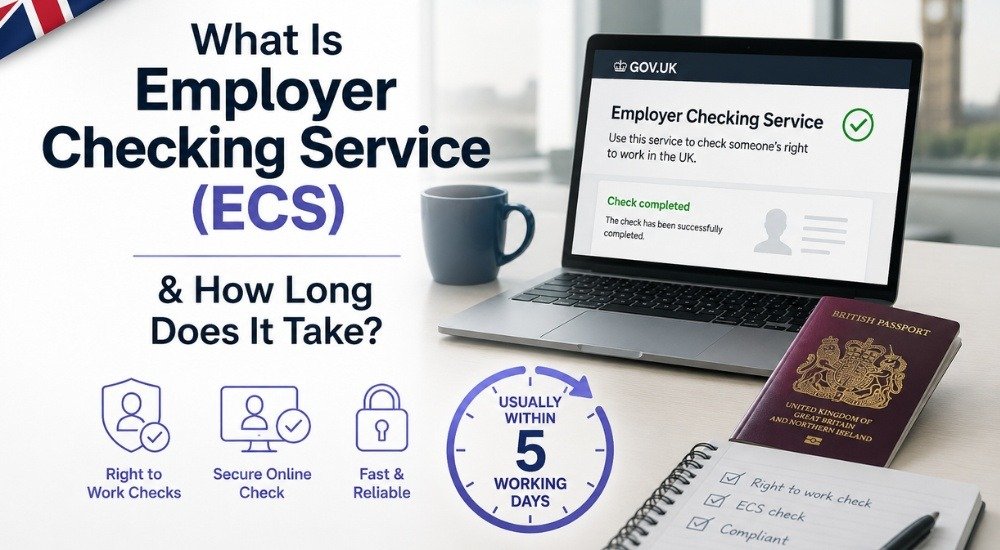
Once a valid request is submitted, the Employer Checking Service aims to provide a response within five working days. This relatively quick turnaround helps ensure that businesses are not left waiting for long periods when making vital recruitment decisions.
However, there is an important waiting period that must be observed before contacting the ECS in certain cases. If an employee or potential employee has recently submitted an application, appeal, or administrative review to the Home Office, employers must wait at least fourteen calendar days after the application was delivered or posted before requesting a verification check. This fourteen-day wait is necessary because it takes this amount of time for most cases to be formally registered onto the Home Office systems. If a check is requested too early, the system might not reflect the recent application, which could lead to an incorrect assessment. In order to make this verification request, confirmation must be obtained from the employee regarding the exact date their application or appeal was made.
Conclusion
In conclusion, the Employer Checking Service acts as a critical safety net for employers navigating complex right to work scenarios. While standard online or manual document checks work for the majority of the workforce, the ECS ensures that individuals waiting on visa decisions, asylum seekers, and long-term residents without traditional documents are not unfairly locked out of employment. By understanding exactly when to use this service, respecting the fourteen-day waiting period for newly submitted applications, and planning for the five-working-day processing time, employers can confidently hire eligible workers while maintaining their legal statutory excuse and keeping their businesses fully protected under United Kingdom immigration laws.
