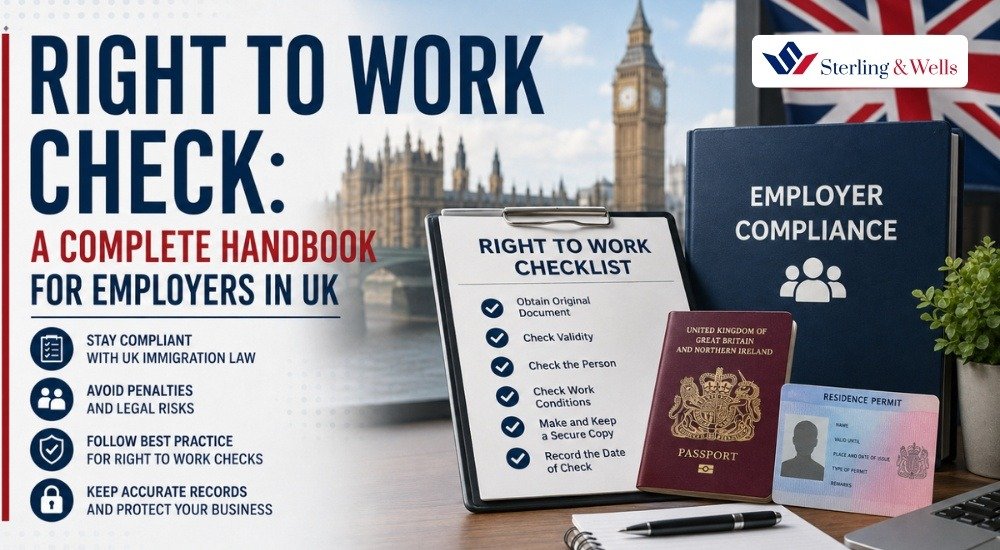
Every employer in the UK has a legal duty to prevent illegal working. You do this by checking that absolutely anyone you employ has the legal right to work in the UK before their first day on the job. This rule applies to all hires, and the employer must consistently check every prospective employee, including British citizens.
You should never assume the right to work based on appearance, nationality, accent, name, or length of UK residence, as doing so is discriminatory and illegal. By doing these checks properly, you establish what is called a “statutory excuse,” which is a legal protection that stops you from being fined if it turns out the worker does not actually have the right to work, provided you followed the government’s checking rules exactly.
How to Conduct a Right to Work Check
Depending on the applicant’s nationality and immigration status, there are three ways to conduct a right-to-work check.

The Home Office Online Check (For most non-British/non-Irish citizens)
For most people from abroad, you do the check online. The Home Office has switched to a digital system, so paper documents like Biometric Residence Permits (BRPs) expired in 2024; now, people get an eVisa, which is an online record of their status. To begin the process, the applicant will log into their account and generate a 9-character “share code” to give to the employer.
For right-to-work purposes, this code must always begin with the letter ‘W’ and is valid for 90 days. You must then go to the specific government website called ‘Check a job applicant’s right to work: use their share code’ on GOV.UK, enter the ‘W’ share code, and the applicant’s date of birth. The system will show you the person’s photo and their work entitlements, at which point you must check that the photograph on the screen genuinely is identical to the person standing in front of you or on a live video call.
Finally, you must save a copy of this online profile page as a PDF, HTML, or printed hard copy and securely store it for the duration of their employment plus two additional years.

Digital Verification Services (DVS) (For British and Irish citizens)
A Digital Verification Service (DVS) is an approved external technology provider that allows you to complete the identity verification part of a right to work check digitally.
To use this service, the applicant must hold a valid British or Irish passport, or an Irish passport card. While the DVS provider will verify the document itself, you are still required to satisfy yourself that the photograph and biographic details provided by the DVS perfectly match the actual person presenting themselves for work. You can conduct this visual check either in person or via a live video call.
If the applicant’s passport has expired, or if they simply do not wish to prove their identity using a digital service, you must not treat them less favourably. Instead, you must provide them with an alternative way to prove their right to work by carrying out a standard manual document-based check.

Manual Document Checks
A manual check involves physically inspecting the worker’s original identity documents. You must do this if the person does not have an eVisa or is a British/Irish citizen who cannot or does not want to use a DVS.
The first step is to obtain the applicant’s authentic, physical documents, such as a valid passport and an official National Insurance document, keeping in mind that expired BRPs are no longer acceptable.
Next, you must check the documents in the presence of the holder, either in person or via live video link while you hold the physical document. You must ensure the photos match the person, the dates of birth are consistent, and the document doesn’t look tampered with.
Finally, you must make a clear copy of the documents, ensuring that for passports, you copy any page showing the expiry date, nationality, date of birth, signature, photo, and any visas or stamps. You must keep this copy and note the date you made the check for the duration of the job plus two years.
What Employers Can Do in Complex Right to Work Check?
Sometimes, you cannot check a person’s status online or manually, which usually happens if the person has an outstanding visa application, an ongoing appeal with the Home Office, or is an asylum seeker using an Application Registration Card (ARC).
In these cases, you must use the Employer Checking Service (ECS), which is a specific Home Office team you can contact online to verify a person’s status. If an employee says they have an application in progress, wait 14 days after they applied before contacting the ECS to give the Home Office time to add it to their system.
If the ECS confirms the person is allowed to work, they will send you a Positive Verification Notice (PVN). This official notice acts as your statutory excuse, covers you for 6 months, and requires another check before those six months run out.
Follow-up Right to Work Check and Grace Periods
If a worker has a time-limited right to work (meaning their visa expires on a certain date), you must do a follow-up check just before that expiration date to keep your statutory excuse.
The 28-day Grace Period
If the employee’s visa expires, but they submit an ‘in-time’ application to extend their stay (meaning they applied before their old visa ran out), their working rights are automatically extended while they wait for a decision. As an employer, you are given a 28-day grace period from the date your visa expired to contact the ECS and get a PVN to cover you for the next 6 months.
TUPE Transfers (Buying a business)
If you acquire staff as part of a business acquisition (known as a Transfer of Undertakings or TUPE), you inherit the previous owner’s right to work checks. However, if the previous owner did them incorrectly, you will be fined. Therefore, you are given a 60-day grace period from the date of the transfer to conduct fresh right-to-work checks on all your new staff.
Special Circumstances in Right to Work Check
Employing International students often has strict rules on how many hours they can work during term time, but they can work full-time during holidays. To prove you are not breaching these rules, you must obtain and keep a copy of their academic term dates and vacation dates from their education provider. Also, students are generally not allowed to fill permanent, full-time vacancies unless they are at the very end of their course and switching to a Skilled Worker Visa or Graduate visa.
Workers Under 16
By law, children under 16 do not need statutory right-to-work checks, and the online checking service doesn’t work for them. However, if your business holds a sponsor licence, you are still required to make sure sponsored workers under 16 have the right to work. You do this simply by asking the child (or their parent) to show you their live eVisa screen and keeping a screenshot for your files.
Self-Employed and Third-Party Workers
If you are sponsoring a worker who is not your direct employee (for example, they are genuinely self-employed or work for a contractor), you are not legally required to get a “statutory excuse” against a fine. However, to keep your sponsor licence safe, you must still carry out right-to-work checks (and retain the copies) to ensure they are allowed to do the work.
Penalties for Failing to Carry Out Right to Work Checks
The government uses a “whole government approach” to find illegal working, sharing data with the tax office (HMRC) and other agencies. If you fail to do these checks properly and are caught employing someone illegally, the punishments are severe:
Civil Penalties
You may be issued a civil penalty of up to £45,000 per illegal worker for a first breach, and up to £60,000 per worker for repeat breaches. If enforcement action is required to force you to pay this penalty, it could adversely affect your ability to obtain credit.
Criminal Conviction
In serious cases where you know or have reasonable cause to believe you are employing an illegal worker; you may be prosecuted and face a prison sentence of up to five years and/or an unlimited fine. You may also face up to 5 years in prison and/or an unlimited fine for possessing false or improperly obtained identity documents, or up to 14 years in prison and/or an unlimited fine if convicted of facilitation or trafficking.
Loss of Sponsor Licence
You will likely lose your ability to sponsor overseas migrants. If issued a civil penalty, your sponsor licence will likely be revoked, and you will not be eligible to apply for a new licence for at least 12 months (or up to 5 years if you receive multiple civil penalties) after the penalty is paid in full.
Business Closure
Persistent or serious offenders may face the temporary closure of their business and be placed under a compliance order issued by a court.
Civil Penalties
You may be issued a civil penalty of up to £45,000 per illegal worker for a first breach, and up to £60,000 per worker for repeat breaches. If enforcement action is required to force you to pay this penalty, it could adversely affect your ability to obtain credit.
Director Disqualification
You may be legally disqualified from acting as a company director.
Seizure of Earnings
Any earnings made because of illegal working may be seized as the proceeds of crime.
Other License Revocations
Your ability to hold operating licences in high-risk sectors, such as the alcohol and late-night refreshment sector, or the private hire vehicle and taxi sector, may be reviewed, suspended, or revoked.
Public Shaming
Your business’s details may be published in a quarterly Home Office report of non-compliant employers who have been issued civil penalties.
Immigration Consequences
If you yourself are subject to UK immigration control, your liability for employing illegal workers will be recorded on Home Office systems and considered when considering any future immigration applications you make.
How Can Sterling & Wells Accountants Help?
Conclusion
Carrying out Right to Work checks might seem like just another administrative task, but it is one of the most critical legal duties for any UK employer. By making these checks a consistent, mandatory part of your hiring process for every single new employee, you create a fair workplace and actively help prevent illegal working. Remember, the goal of strictly following these government rules is to secure your “statutory excuse”. This is your business’s legal safety net.
By taking the time to use the Home Office online service correctly, an approved DVS, or by carefully conducting manual document checks before employment begins, you protect your company from devastating consequences. Failing to establish this excuse can lead to massive civil penalties, the loss of your ability to sponsor overseas workers, and even criminal prosecution.
To stay compliant, remain organised, keep clear and secure copies of every document you verify, and always record the exact date the check was made. If an employee’s status is ever unclear, or if they have an outstanding visa application, always rely on the Home Office ECS to guide you and provide the necessary official confirmation.
