
A marketing agency downsizes and rents out the floor it no longer needs. The rent is treated as VAT-exempt, so no VAT is charged, and at first, nothing appears to change. The returns go in on time, the figures reconcile, and nobody raises a query. Then a compliance check lands, and it turns out the agency should have been restricting input tax recovery on relevant shared property and overhead costs from the day the tenant moved in. Several years of over-claimed VAT come back, with interest and a penalty on top.
Nobody in that story set out to get it wrong, and that is what makes VAT exempt supplies expensive. They are one of the few areas of VAT where carrying on exactly as you were can itself be the mistake.
This guide covers what counts as exempt, why outside the scope is a different category, how partial exemption decides what you keep, and what happens when HMRC finds the error first.
KeyTakeaways
-
VAT exempt supplies carry no VAT and normally carry no right to recover the input tax on related costs. That VAT is a permanent cost, not a timing difference.
-
Outside the scope is not a softer version of exempt. It is a separate category with different recovery consequences, and treating the two as interchangeable is one of the most expensive errors here.
-
Zero-rated and exempt look identical on an invoice and behave in opposite ways on your return, and exempt income does not count toward the £90,000 registration threshold.
-
Rental income is the most common trigger. Most businesses become partly exempt by letting out space, not by moving into finance or healthcare.
-
The de minimis rules can hand back everything, but only if you pass both limbs of the test. Missing by a few hundred pounds costs you the full amount.
-
Quarterly figures are provisional. The annual adjustment is where a year of over-claimed VAT becomes payable in one hit.
Take that second point seriously.
Exempt means the supply is inside the VAT system and specifically relieved from tax, so the input tax on related costs is normally lost.
Outside the scope means the supply never entered the system at all; depending on why, you may keep full recovery or lose it entirely.
What are VAT exempt supplies, what is outside the scope of VAT, and how does partial exemption work?
In simple terms, VAT exempt supplies are transactions that fall within the VAT system but are specifically relieved from VAT under UK legislation. VAT exempt supplies in the UK fall into specific statutory categories and are treated differently from zero-rated and outside-the-scope income. They carry no VAT, and you normally cannot recover the input tax on costs used to make them, so that VAT becomes part of your cost base permanently. Supplies outside the scope never enter the UK VAT system at all.
Partial exemption sits between the two. A business making only taxable supplies recovers all its input tax, one making only exempt supplies recovers none, and most businesses caught here land in the middle. Partial exemption is the arithmetic deciding how much of the input tax on your shared costs you keep. Get it wrong, and you are over-claiming on every return until someone notices.
Could renting out spare space really make my business partly exempt?
Yes, and for most businesses, this is the most likely way it happens. Rent from land and buildings is exempt unless you have opted to tax, so the moment you let out space without an option in place, you are partly exempt.
Most businesses dealing with VAT exempt supplies in the UK are not finance houses or insurers. They are agencies, consultancies, manufacturers, retailers, and professional firms that take on more space than they need, downsize, or inherit a building with a tenant in it. The restriction starts on the day the letting begins. From that date, the input tax on every cost used across the building becomes residual: heat, light, insurance, repairs, security, cleaning and a share of professional fees. Nothing on the bank statement flags it, which is why businesses can run for years before recovery is restricted.
Common mistake
Assuming that because the rent is small, it cannot matter. What drives the restriction is the size of your residual input tax and the ratio between taxable and exempt turnover. A modest rent attached to an expensive building can cost far more in blocked VAT than the rent is worth.
Refurbishment is the related trap. Spend heavily on a building that is partly let, and you are restricting recovery on a very large number. If the spend exceeds £600,000 excluding VAT, the position is reviewed annually for 10 years under the Capital Goods Scheme.
This threshold rose from £250,000 with effect from 29 July 2026. The test is when the expenditure is incurred, not when it was committed: for buildings, the new threshold applies where they are acquired, constructed, refurbished, fitted out, altered or extended on or after that date. Anything already in the scheme before 29 July 2026 continues under the old rules until its adjustment period ends.
How do I know if income is outside the scope of VAT?
Income is outside the scope when it is not consideration for a taxable supply made in the UK. Common examples are:
-
Supplies with a place of supply outside the UK, including many services supplied to overseas business customers
-
Non-business activities, which are especially important for charities and membership bodies
-
Dividends and salaries
-
Genuine donations and grants where the payer receives nothing in return
The input tax treatment does not work the same way in every case. Exempt supplies normally restrict VAT recovery. Supplies made outside the UK that would have been taxable if made in the UK can still carry a right to deduct. Non-business activity is different again: VAT relating to non-business activity is not input tax at all and must be dealt with before the partial exemption calculation starts.
| Feature |
VAT Exempt Supplies |
Zero-Rated Supplies |
Outside the Scope |
|---|---|---|---|
| 🖥️❓ Is it within the UK VAT system? | Yes | Yes | No |
| 📋🧮 Counts toward the £90,000 registration threshold? | No | Yes | No |
| 💰🔄 Input tax recovery on related costs | Normally restricted | Full recovery | Full recovery if the supply would have been taxable had you made it in the UK. None if the activity is non-business |
| ⚖️🔺 Does it create partial exemption issues? | Yes | No | Not directly, but non-business activity triggers a separate restriction that comes first |
| 💡 Typical example | Rent where no option to tax is in place | Most food and children's clothing | Consultancy fees billed to an overseas business customer |
Every group carries conditions that narrow it considerably, and health and welfare, education and finance are far tighter than the headings suggest. Land is the group most likely to create a partial exemption problem for an ordinary trading business.
What counts as a VAT exempt supply in the UK?
VAT exempt supplies come from a closed statutory list of sixteen groups, and if a supply is not on that list, it is not exempt. Businesses often assume a supply must be exempt because it feels like it should be, and a wrong assumption means either output tax you never charged or input tax you wrongly claimed. The groups are:
-
Land, covering most rent and sales of existing buildings
-
Insurance, including broking and agency services
-
Public postal services
-
Betting, gaming and lotteries
-
Finance, including most banking, credit and intermediary services
-
Education and private tuition by eligible bodies
-
Health and welfare
-
Burial and cremation
-
Trade union and professional body subscriptions
-
Sport, sports competitions and physical education
-
Works of art and similar disposals
-
Fundraising events by charities
-
Cultural services
-
Goods where input tax could not be recovered
-
Investment gold
-
Services supplied by cost sharing groups
Every group carries conditions that narrow it considerably, and health and welfare, education and finance are far tighter than the headings suggest. Land is the group most likely to create a partial exemption problem for an ordinary trading business.
Is exempt the same as zero-rated?
No, and confusing the two is probably the most expensive misunderstanding in UK VAT. Both may result in no VAT being charged to the customer, but that is where the similarity ends. Zero-rating is a taxable supply charged at 0%, and it normally preserves input tax recovery. Exemption is different: it usually blocks or restricts the recovery of input tax. A food manufacturer selling zero-rated groceries can normally recover VAT on its factory costs. A dental practice supplying exempt clinical care generally cannot recover VAT on costs directly related to those exempt supplies.
Common mistake
Many businesses assume that because no VAT appears on an invoice, the income must be exempt. In reality, income can be exempt, zero-rated, or outside the scope. All three can show no VAT on the invoice, but they produce very different VAT recovery outcomes. Always identify the correct category before deciding how much input tax can be reclaimed.
Do exempt sales count toward the £90,000 VAT registration threshold?
No. Taxable turnover means the value of your taxable supplies, which covers standard-rated, reduced-rated and zero-rated supplies. Exempt income and most outside-the-scope income are excluded, so a business with £400,000 of exempt income and £60,000 of standard-rated sales has no requirement to register.
That cuts both ways. Businesses in this position often register voluntarily to recover VAT on a big purchase, then find partial exemption hands back a fraction of what they budgeted for. Model the position before you file, not after the money is spent.
How does partial exemption actually work in practice?
Partial exemption works in three stages, in this order:
Three-stage input tax recovery process
| Stage | Process |
Recovery outcome |
|---|---|---|
| ⇝ 1. Direct attribution |
Split input tax into taxable and exempt supplies |
Taxable is fully recoverable; exempt is not |
| % 2. Apportionment |
Apply taxable turnover percentage to residual input tax |
Recover share matching taxable turnover percentage |
| 🗓️ 3. Annual adjustment |
Redo calculation on twelve months of figures |
Settle up at end of VAT year |
The recovery percentage under the standard method is rounded up to the next whole number, unless the business incurs more than £400,000 of residual input tax per month on average, in which case it is rounded to 2 decimal places. Sales of capital assets you have used in the business are excluded from the calculation because a single large disposal would distort it, and blocked input tax, such as VAT on entertainment and most cars, is deducted before you start.
The standard method is the default and needs no permission. If it gives an unfair result, you can apply for a special method, which needs written approval. There’s also a backstop called the standard method override, which applies if your residual input tax exceeds £50,000 a year and the standard method produces a result that’s substantially different from what use-based recovery would. HMRC treats a difference as substantial if it is more than £50,000, or more than 50% of your residual input tax where that difference also exceeds £25,000.
What is the de minimis rule, and how do I know if I pass it?
Monthly
Total
You pass de minimis when your exempt input tax is small enough to recover in full, and two conditions must be satisfied together. HMRC calls this Test Three, which is the name used in the worked example below.
- Exempt input tax of no more than £625 per month on average, which is £1,875 a quarter or £7,500 a year
- Exempt input tax of no more than half your total input tax for the period, known as the 50% test.
Fail either, or you are outside de minimis entirely. There is no partial credit. A business with £7,600 of exempt input tax for the year has exceeded the £7,500 annual limit, so none of that exempt input tax is recoverable, not merely the £100 above the limit.
Common mistake
Spotting the £625 figure, confirming you are under it, and never applying the 50% test. Both limbs must be met. This shows up most often in businesses with low total input tax, where a small amount of exempt VAT is easily more than half.
Two further tests can save you from running the full calculation each quarter, and passing any one of the three is enough. Under Test One, you pass if total input tax is no more than £625 a month on average and the value of exempt supplies is no more than half the value of all your supplies. Under Test Two, the same two limits apply, but you look at total input tax less the input tax directly attributable to taxable supplies. The 50% test in Test One and Test Two differs from the 50% test above: it compares the value of exempt supplies to the value of all supplies, rather than exempt input tax to total input tax.
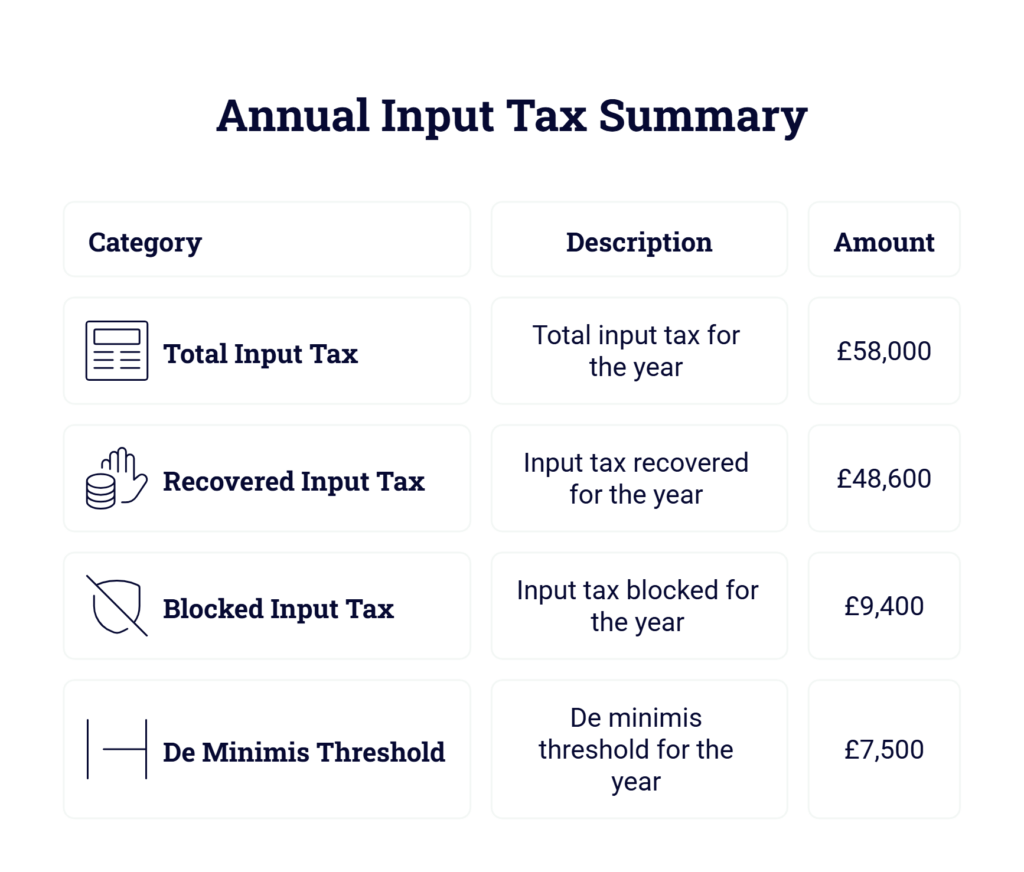
An agency owns a two-floor building. After a restructure, it needs half the space, so it lets the ground floor with no option to tax, making the rent exempt. The annual figures are:
- Taxable agency fees: £600,000
- Exempt rental income: £120,000
- Input tax on costs used only for the agency business: £15,000
- Input tax on costs used only for the letting: £3,000
- Residual input tax on building costs, utilities, IT, accountancy and marketing: £40,000
Total supplies are £720,000, of which £600,000 is taxable, giving a recovery rate of 83.33%, which rounds up to 84%. Apply that to the £40,000 residual pot, and £33,600 is recoverable, leaving £6,400 against exempt supplies. With the £3,000 directly attributable, the agency has £9,400 of exempt input tax for the year.
Now test it against all three routes to de minimis. Test One fails straight away: total input tax is £58,000, well above the £7,500 annual limit. Test Two fails too: strip out the £15,000 directly attributable to taxable supplies, and £43,000 is still well above £7,500. Test Three comes closest: exempt input tax is £9,400, above the £7,500 limit, so that condition fails, even though the second condition of Test Three, exempt input tax against half of total input tax, £9,400 against £29,000, would have passed on its own.
Because every test requires both conditions to be met, and the agency fails at least one condition in each of the three, it is not de minimis. Recoverable input tax is £48,600, and the remaining £9,400 is gone.
Look at how close that is. Had exempt input tax been £7,500 or less, Test Three would have passed, and the agency would have recovered every penny. It missed by £1,900 and lost £9,400; four years of this, without adjusting, is roughly £37,600 in over-claimed VAT, plus interest and penalties.
What happens if HMRC finds a partial exemption error?
If HMRC finds a partial exemption error, the business may have to repay the over-claimed VAT, with interest and possibly penalties. The normal assessment period is generally four years, but HMRC can go back further for deliberate errors.
If the business finds the error first, it may be able to correct it on the next VAT return if the net error is £10,000 or less. Errors up to £50,000 can also be corrected on the next VAT return if they are no more than 1% of the total value of sales and other outputs shown on that VAT return. Larger errors, and deliberate errors, must be notified to HMRC separately.
An unprompted disclosure before HMRC starts asking questions usually gives a better penalty position than waiting until a compliance check has begun.
Why did my VAT recovery change after the annual adjustment?
The annual adjustment is where you redo the calculation using a full year of figures, and it catches people out because everything claimed quarterly was only provisional. Your VAT year normally ends on 31 March, 30 April or 31 May, depending on your prescribed accounting year. Seasonal businesses can pass de minimis in three quarters and fail for the full year, repaying VAT already incurred in a single payment. This is one of the most common reasons businesses discover a partial exemption issue at year-end rather than during their quarterly VAT returns.
What happens if I own property or make a big capital purchase?
Large capital spending gets its own regime. The Capital Goods Scheme applies to land, buildings, civil engineering works and refurbishments worth £600,000 or more excluding VAT, and to aircraft, ships and boats worth £50,000 or more, with recovery revisited annually over ten intervals for land, buildings and civil engineering works, and five for aircraft, ships and boats. This £600,000 threshold has applied since 29 July 2026, up from the previous £250,000, and computer equipment has been removed from the scheme entirely. So if a partly exempt business buys or refurbishes premises above this threshold and its exempt income grows over the following decade, VAT recovered on day one may need to be repaid in stages.
The option to tax is the other half. Opting converts exempt rent into standard-rated income and unlocks recovery, but it is locked in for twenty years and can make a property much harder to let to exempt occupiers such as care providers, financial firms and schools.
What should I check today?
Work through this list. It takes an afternoon and will tell you whether you have a problem.
- List every income stream and flag anything with no VAT on it, especially rent and license fees
- Split turnover into taxable and exempt for the last twelve months, and input tax into directly attributable taxable, directly attributable exempt, and residual
- Run both limbs of the de minimis test on the full year, not a single quarter
- Confirm an annual adjustment was done last year and that someone can show you the calculation
- Confirm whether an option to tax exists on every property you own or occupy, and identify capital spend above £600,000 on property on or after 29 July 2026 (£250,000 before that date) going back ten years, or above £50,000 on aircraft, ships and boats going back five years
If you cannot answer the annual adjustment question, that is your finding. Start there.
Frequently Asked Questions
Not automatically, but usually. Rent is exempt unless you have opted to tax, so letting out space makes you partly exempt from the date the letting begins, unless the exempt input tax falls within the de minimis limits.
Yes. If your exempt input tax falls within the de minimis limits, you may recover all of it. Certain specified supplies, mainly financial and insurance services supplied to customers outside the UK, can also preserve the right to recover related input tax.
Generally, no. The main exception is land and buildings, where an option to tax converts exempt income into taxable income and restores the ability to recover. That option usually cannot be revoked for twenty years, so model it before you make it.
Deliberate errors have no four-year limit” to “The normal four-year limit does not apply to deliberate errors, where HMRC may be able to assess further back.” This is more precise.
Yes, and doing it before HMRC asks is much cheaper. Net errors up to £10,000 can be adjusted on your next return, as can errors up to £50,000 staying within 1% of your total sales figure. Larger errors are notified separately.
Yes, but less than people fear. You must record output values split by rate, including exempt supplies. The calculation itself need not be done inside the software, and no digital link is needed for the workings. What must be recorded digitally is the total of each adjustment, on its own line.
The businesses that suffer the biggest VAT adjustments are rarely the ones trying to avoid tax. They are the ones that never realised a single exempt income stream changed their recovery position. A tenant moved into the spare floor. A new service line turned out to be exempt. The consequence surfaces a year or two later, by which point the cash has been spent, and the interest clock has been running.
The mistakes repeat: treating outside-the-scope and exempt as the same thing, assuming 0% on an invoice means recovery is safe, checking the £625 figure and forgetting the 50% test, and leaving out space while changing nothing in the bookkeeping.
If your business has taken on property, introduced a new service line, or never reviewed its partial exemption position, checking now is cheaper than explaining later. Do it before your VAT year ends, because the options are far better on that side of the date.
