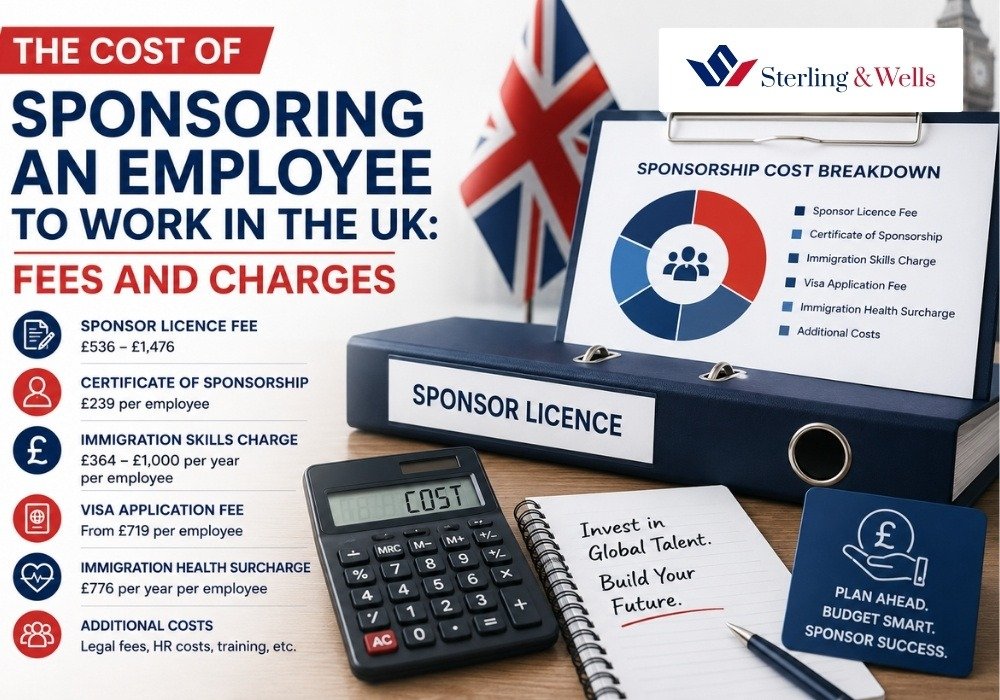
Sponsoring a skilled worker is rarely a single, predictable expense. The sponsor licence fee is only the starting point. Once you add the Immigration Skills Charge, the Certificate of Sponsorship fee, the worker’s visa costs and any priority processing, the total for one sponsorship can run to tens of thousands of pounds, and the figures multiply quickly for employers hiring several people.
This article sets out the main fees involved in sponsoring a worker on the Skilled Worker route, from the licence application through to the visa being granted. The authoritative source for all current fees is the Home Office guidance and the details of the sponsor licence itself, including how to apply. All figures in this article reflect the fee schedule in force from 8 April 2026.
KeyTakeaways
-
The sponsor licence fee is a one-off cost paid by the employer: £611 for small or charitable sponsors and £1,682 for medium or large sponsors.
-
The Immigration Skills Charge is paid per worker and reaches £6,600 for a five-year sponsorship at the medium or large rate.
-
Each Certificate of Sponsorship for a Skilled Worker costs £525, payable by the employer at assignment.
-
The worker's visa fee and the Immigration Health Surcharge are separate costs the employer may choose to meet.
-
Priority processing adds £500 to £1,000 per application and is optional but often necessary.
-
A medium-sized employer sponsoring one worker with a spouse and child for five years (meeting all visa and health costs) should budget around £28,391 in government fees alone, before professional service costs.
The Sponsor Licence Fee
The first cost is the sponsor licence application fee, a one-off fee paid to the Home Office when you apply for a licence. You cannot assign a Certificate of Sponsorship, and your workers cannot apply for a visa, until the licence is in place. The fee depends on the size of your organisation.
|
Employer category
|
Worker sponsor licence fee
|
|---|---|
|
Small or charitable sponsor
|
£611
|
|
Medium or large sponsor
|
£1,682
|
Who qualifies as a small sponsor?
You qualify for the lower rate if at least two of the following apply: annual turnover of £15 million or less; total assets of £7.5 million or less; or 50 employees or fewer. Registered charities qualify for the small-sponsor rate regardless of size. Any organisation that does not meet the small or charitable test pays the medium or large fee.
Refunds and renewals
The licence fee is not refundable if your application is refused or withdrawn, or if you later decide not to use the licence. It is a processing fee, not a deposit. Since April 2024, licences are granted for as long as you continue to meet the eligibility requirements and no longer need periodic renewal, so for most businesses the fee is a genuine one-off cost. Scale-up and UK Expansion Worker licences remain time-limited to four years.
The Immigration Skills Charge
The Immigration Skills Charge (ISC) is a per-worker levy paid by the sponsor each time a Certificate of Sponsorship is assigned to a Skilled Worker, or to a Senior or Specialist Worker under the Global Business Mobility route. It is separate from the licence fee and is intended to encourage investment in the domestic workforce. The current rates, applicable per worker per sponsorship, are:
|
Period
|
Small or charitable sponsor
|
Medium or large sponsor
|
|---|---|---|
|
First 12 months
|
£480
|
£1,320
|
|
Each additional 6 months
|
£240
|
£660
|
The charge is based on the total period of sponsorship stated on the certificate, not the actual length of employment. The first 12 months are charged at the annual rate and each further six-month period at the six-monthly rate. For a medium or large employer sponsoring a worker for five years, that is £1,320 for the first year plus eight further six-month periods at £660 each (£5,280), giving £6,600 in total. The equivalent for a small or charitable sponsor is £2,400.
Who pays, and who is exempt
The ISC must be paid by the sponsor and must never be passed on to, or recovered from, the worker. Doing so is a serious compliance breach that can lead to licence revocation. Some workers are exempt, including those sponsored in specified science and academic occupation codes (such as biological scientists and higher education teaching professionals), those switching to the Skilled Worker route from a student or Graduate visa, and certain intra-EU transfers under the Global Business Mobility route. A partial refund is available for unused complete six-month periods if a worker leaves early, but the first 12 months are never refundable. For further detail on ISC refunds, see our related Immigration Skills Charge refund guide.
The Immigration Skills Charge is established by the Immigration Skills Charge Regulations 2017 (SI 2017/499), made under the Immigration Act 2014, s.70A. The refund provisions are set out in Regulation 6 of SI 2017/499. Current rates are set by the Immigration and Nationality (Fees) Regulations 2017 (SI 2017/515), as amended by SI 2025/319, in force from 16th December 2025.
The Certificate of Sponsorship Fee
Before a worker can apply for a Skilled Worker visa, the sponsor must assign them a Certificate of Sponsorship (CoS), a unique reference confirming the sponsor’s approval of the role and salary. The CoS fee is £525 per certificate, per application, payable by the sponsor at the point of assignment through the Sponsorship Management System. The fee is charged per certificate: if a worker later needs a new CoS for a significant change of role or an extension, a further £525 applies.
Defined and undefined certificates
There are two types of CoS, both costing £525 per certificate. A defined CoS is used for out-of-country applications, where the worker applies for entry clearance to come to the UK; sponsors request these individually through the Sponsorship Management System. An undefined CoS is used for in-country applications, where the worker is already in the UK and is switching or extending. The CoS fee is not refundable if the certificate expires unused or the visa is refused.
The Certificate of Sponsorship fee is set under the Immigration and Nationality (Fees) Regulations 2017 (SI 2017/515), Schedule 1, Part 7, as amended by SI 2025/319. The legal framework for the CoS derives from the Immigration Rules, Appendix Skilled Worker, paragraphs SW 1.1 et seq., as laid before Parliament under the Immigration Act 1971, s.3(2).
The Visa Application Fee
The visa application fee is payable by the worker rather than the employer, but many employers meet it as part of the package, particularly when recruiting internationally. These fees are charged per person, per application. The fee depends on the length of leave applied for and whether the application is made inside or outside the UK.
|
Application type
|
Up to 3 years
|
More than 3 years
|
|---|---|---|
|
Out-of-country (entry clearance)
|
£819
|
£1,618
|
|
In-country (leave to remain)
|
£943
|
£1,865
|
Dependants (partner and children) are charged the same visa fee each, per person. A worker applying from overseas for five years with a spouse and one child would therefore face three fees of £1,618, or £4,854 in total, before the health surcharge.
Immigration Health Surcharge
Most applicants must also pay the Immigration Health Surcharge (IHS) to access the NHS during their stay. It is paid up front, per person, and covers the full period of leave.
|
Applicant category
|
Annual IHS rate
|
|---|---|
|
Adults (18 and over)
|
£1,035 per year
|
|
Children (under 18) and certain categories
|
£776 per year
|
Over five years the IHS is £5,175 per adult. For a worker, spouse and one child, the combined five-year surcharge is £5,175 + £5,175 + £3,880 = £14,230. Health and Care Worker visa holders are exempt from the IHS.
The visa application fee is charged under the Immigration and Nationality (Fees) Regulations 2017 (SI 2018/330), as amended by SI 2025/319. The Immigration Health Surcharge is charged under the Immigration Act 2014, s.38, and the Immigration (Health Charge) Order 2015 (SI 2015/792), as amended by the Immigration (Health Charge) (Amendment) Order 2024 (SI 2024/55).
Priority Service Fees
Standard processing can take from around three weeks for a straightforward out-of-country application to several months in busy periods. Where a start date matters, the Home Office offers optional priority services at extra cost.
Priority service fees are charged per application, not per person. A single fee covers the entire application, including any dependants included within it. If the main applicant and dependants apply separately, a priority fee applies to each separate application.
|
Service
|
Target time
|
Free
|
|---|---|---|
|
Priority visa service (in or out of UK)
|
5 working days
|
£500
|
|
Super priority service
|
Next working day
|
£1,000
|
|
Priority service for sponsor licence
|
10 working days
|
£750
|
Priority slots are limited and released on a first-come, first-served basis, so they cannot be relied upon. The stated times are targets, not guarantees, and the fee is not refunded if a decision takes longer.
Priority and super priority service fees are set under the Immigration and Nationality (Fees) Regulations 2017 (SI 2018/330), as amended. Availability of priority services is determined by the Home Office on a rolling basis; see www.gov.uk for current availability.
Professional Service Fees
Most employers use a regulated immigration adviser or solicitor to manage the process. These are not government fees and are entirely separate from the charges set out above. Professional fees vary considerably depending on the complexity of the case, the adviser’s experience and location, and the level of ongoing support required. The figures below are indicative market ranges only; the actual fee will depend on the individual firm you engage and should always be confirmed in writing before instruction.
|
Service
|
Indicative fee range
|
|---|---|
|
Sponsor licence application (small employer)
|
£800 to £1,500
|
|
Sponsor licence application (large employer)
|
£1,500 to £3,500
|
|
Skilled Worker visa application (per worker)
|
£1,000 to £2,500
|
|
Ongoing compliance retainer (annual)
|
£1,200 to £4,000+
|
Only regulated advisers may provide immigration advice and services in the UK for gain. Solicitors are regulated by the Solicitors Regulation Authority. Immigration advisers who are not solicitors must be registered with the Immigration Advice Authority (IAA) at the appropriate competence level for the work they carry out. Using an unregulated adviser is a criminal offence under the Immigration and Asylum Act 1999, s.91.
Total Cost Example
A UK technology company, a medium or large employer, applies for its first sponsor licence and sponsors a software engineer from overseas for five years. The worker applies from outside the UK with a spouse and one child, and the employer opts for priority processing and meets all visa and health costs on the worker’s behalf.
|
Cost element
|
Paid by
|
Amount
|
|---|---|---|
|
Sponsor licence fee (medium/large)
|
Employer
|
£1,682
|
|
Certificate of Sponsorship fee
|
Employer
|
£525
|
|
Immigration Skills Charge (5 years, medium/large)
|
Employer
|
£6,600
|
|
Priority visa service
|
Employer
|
£500
|
|
Visa fee per person: main applicant (5 yr, out of country)
|
Employer
|
£1,618
|
|
Visa fee per person: spouse (5 yr, out of country)
|
Employer
|
£1,618
|
|
Visa fee per person: child (5 yr, out of country)
|
Employer
|
£1,618
|
|
IHS per person: main applicant (5 x £1,035)
|
Employer
|
£5,175
|
|
IHS per person: spouse (5 x £1,035)
|
Employer
|
£5,175
|
|
IHS per person: child (5 x £776)
|
Employer
|
£3,880
|
|
Total government fees
|
|
£28,391
|
|
Professional fees (illustrative mid-range)
|
Employer
|
£3,500
|
|
Total including professional fees
|
|
£31,891
|
Based on fee levels in force in 2026. Figures assume a five-year certificate; professional fees are mid-range estimates only.
The licence fee is a modest entry cost. It is the combination of the Skills Charge, the health surcharge for a whole family and professional fees that pushes the total into the tens of thousands. For employers hiring at scale the figures compound: sponsoring five workers for five years each carries an ISC liability of £33,000 alone, before any other cost.
Further Costs to Consider
A few additional costs are easy to overlook. Where a worker’s degree or identity documents are not in English, certified translations can add several hundred pounds. Applicants attending an overseas visa application centre may pay for premium appointment services, typically £100 to £200 per person. Right-to-work checks using the Home Office online service are free, but you must keep a compliant record for each worker.
After five years of continuous lawful residence a Skilled Worker who qualifies can apply for Indefinite Leave to Remain (ILR), currently £3,226, at which point sponsorship and ongoing sponsorship costs end for that individual. If you have agreed to fund ILR as part of the employment package, budget for it at the five-year mark.
Frequently Asked Questions
No. Neither the sponsor licence fee nor the Immigration Skills Charge, nor the CoS fee, can be passed on to the worker, deducted from wages or recovered if they leave early. The Home Office treats attempts to do so as a serious breach that can lead to revocation.
No. The visa fee and health surcharge are the worker’s responsibility. Many employers meet them to make an offer competitive, and there is no rule preventing this.
A partial refund of the ISC may be available for unused complete six-month periods after the first 12 months. You must report the worker’s last day through the Sponsorship Management System within 10 working days. The first 12 months of ISC, the CoS fee and the sponsor licence fee are not refundable in any circumstances.
Sponsor licence fees, CoS fees, the Immigration Skills Charge and professional adviser fees incurred wholly and exclusively for the employer’s trade are generally deductible as a business expense under the Corporation Tax Act 2009, s.54. Whether meeting a worker’s visa fee or IHS creates a taxable benefit in kind is a separate question that turns on the specific arrangement, and you should take specific advice on this point.
Conclusion
The cost of sponsoring a worker is higher than most employers first expect. The sponsor licence fee is the visible entry point, but the Skills Charge, CoS fee, priority processing and, where the employer meets them, the worker’s visa and health costs quickly add up. For a medium or large employer sponsoring one worker with a family of three for five years, government fees alone exceed £28,000, with professional fees on top.
Employers planning a programme of overseas recruitment should model the full cost per hire before committing, and review their entitlement to Skills Charge refunds if workers leave early.
At Sterling Wells we help employers plan and manage the full sponsorship process, from the initial licence application through to ongoing compliance and refund claims. To understand the costs for your own circumstances, please get in touch.
