
If your business is buying property, taking on investors, or expanding overseas, a group structure may reduce risk and cut your tax bill, but it isn’t automatic or free. This article explains when HMRC treats companies as a group, what triggers justify forming one, and where the planning fails. If none of the circumstances discussed below applies to you, staying as a single company is the simpler and cheaper option, and you can stop reading here.
Key Takeaways
A group structure exists when two or more companies are linked by common ownership, with each remaining a separate legal entity with its own accounts and tax return.
For group relief, HMRC generally requires at least 75% ownership of a subsidiary's ordinary share capital, plus at least 75% entitlement to its profits and assets under the Corporation Tax Act 2010.
For capital gains group treatment, a company needs only to be an "effective 51% subsidiary," entitled to more than 50% of the profits and assets under TCGA 1992, s.170.
A group structure ring-fences risk, so a claim against one company doesn't automatically expose the others provided the separation is genuine.
Running a group adds compliance cost, so it's usually only worth setting up once there's a genuine trigger, such as buying property, taking on investors, or expanding overseas.
Does Your Business Actually Meet the 75% Group Test?
Your companies form a tax group only if one holds at least 75% of another’s ordinary share capital and at least 75% of the entitlement to its profits and assets; for capital gains purposes, the bar is lower, at an “effective 51% subsidiary.” Below these thresholds, group relief and asset transfer reliefs are not available, regardless of how the businesses are run day-to-day.
Under the Corporation Tax Act 2010, the parent generally needs at least 75% of a subsidiary’s ordinary share capital, plus at least 75% entitlement to its profits and assets, before group relief becomes available. For capital gains purposes, the company must still be a 75% subsidiary on the share capital test. Still, it only needs to be an “effective 51% subsidiary,” beneficially entitled to more than 50% of the profits and assets under TCGA 1992, s. 170. That lower entitlement bar means more companies qualify for tax-neutral asset transfers than for loss relief.
What changes is that specific tax rules, such as group relief and asset transfers, apply because the companies form part of the same group, and consolidated group accounts may be required. Legally, nothing changes day-to-day: each company keeps its own bank account, its own statutory accounts, and its own corporation tax return, and Companies House still registers each one separately.
What Does a Typical UK Group Structure Look Like?
Holding Company Structure
The parent company holds a controlling stake, often 100% of the shares, giving it the voting rights to direct major decisions across each subsidiary. This is what most people mean by “group”: a holding company with subsidiaries. Where the ownership and entitlement conditions above are met, the group can also access group relief and no-gain, no-loss asset transfers.
Two related arrangements often sit alongside a holding structure, though neither is automatically a group under the CTA 2010 or the TCGA 1992. Some groups participate in joint ventures, in which two or more companies jointly own and manage a separate entity for a specific project, often on a 50/50 basis. Because a joint venture partner typically holds less than the ownership levels required for group relief or capital gains group treatment, the joint venture usually sits outside the group’s tax reliefs unless one party’s interest is large enough to qualify.
You’ll also hear “management company structure” used loosely, but this isn’t a separate way of forming a group; a group still depends on ownership links, not just an agreement. What’s usually meant is a management company set up as a subsidiary within an existing group, providing shared services such as administration, payroll, or IT support to the trading companies.
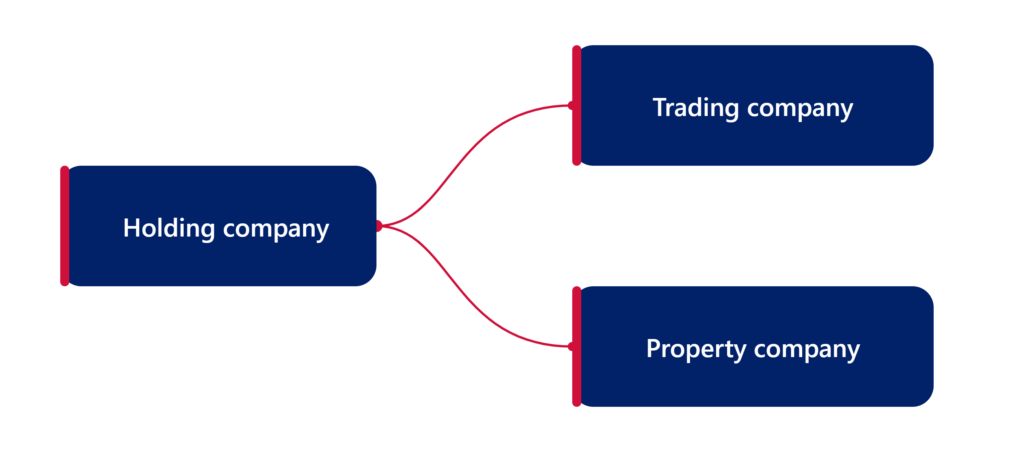
The holding company owns 100% of each subsidiary. Trading risk sits with the trading company; the property and any claim against the group’s assets sit separately in the property company.
| Factor | Single Company | Group Structure |
|---|---|---|
| Asset protection | Limited; everything sits inside one legal entity. | Stronger; risk and valuable assets can be held separately. |
| Tax planning flexibility | Lower. | Higher; group relief and no-gain, no-loss transfers available. |
| Administration | Simpler; one set of accounts, one tax return. | More complex; each company files its own. |
| New ventures | Sit inside the same risk pool as everything else. | Can be ring-fenced in their own subsidiary. |
| Brand separation | Limited. | Each subsidiary can run its own identity. |
When Is a Group Structure Actually Worth It?
A group structure is worth setting up once a business has property, investors, or overseas plans to protect, because that’s the point where the tax reliefs and asset protection it unlocks start to outweigh the extra compliance cost of running multiple companies.
Does Ring-Fencing Actually Protect Assets from Trading Risk?
Yes, provided the separation is genuine: assets held in a separate subsidiary are generally protected from a claim against the trading company, but only if the subsidiary hasn’t guaranteed the trading company’s debts or otherwise exposed its own assets.
This is usually the main driver for setting up a group. Different parts of a business carry different levels of risk, and keeping them in separate companies stops a problem in one area from spreading to the rest. This is often called ring-fencing, and it’s standard practice in industries where trading risk runs high, such as construction, hospitality, and financial services.
How Much Can Group Relief Actually Save?
Group relief lets a loss-making subsidiary surrender its trading losses to a profitable group company in the same accounting period, directly cutting that company’s corporation tax bill in the year the loss arises.
UK groups can access two main reliefs once the ownership tests are met. Group relief under FA 2010 Part 5 works as above. No-gain, no-loss transfers under TCGA 1992 s.171 allow most assets to move between group companies without triggering an immediate capital gain.
Worked Example
Say a subsidiary makes a £120,000 trading loss in a year when a sister company in the group makes £400,000 profit. Both companies meet the 75% ownership and entitlement tests, allowing the loss to be surrendered.
| Scenario | Taxable Profit | Corp Tax (25%) |
|---|---|---|
| Without group relief | £400,000 | £100,000 |
| With group relief (£120,000 surrendered) | £280,000 | £70,000 |
The group pays £70,000 instead of £100,000, a cash saving of £30,000 in that accounting period. These figures are illustrative; the correct position depends on your specific facts, and both reliefs carry anti-avoidance conditions under FA 2010 Part 5 and TCGA 1992 s.171, so it’s worth getting this checked before relying on either.
Operational Efficiency and Focus
Splitting functions across entities lets each business unit be managed, budgeted, and measured on its own terms, rather than being buried in a single set of accounts, producing sharper KPIs and clearer accountability at the business unit level.
Why Does International Expansion Usually Mean a New Subsidiary?
A local subsidiary lets the group hire staff under local employment law, register for local taxes, and contain liabilities arising in that market within the local entity, rather than exposing the whole group to them.
When Does a Group Structure Fail or Not Work?
The planning fails most often when the separation between companies is not genuine, when the ownership thresholds are not actually met, or when a company leaves the group within the anti-avoidance window.
HMRC can and does challenge group structures where subsidiaries share bank accounts, board minutes, or day-to-day management with the parent. If the separation is only on paper, the asset protection and the tax reliefs both fail together, since the entities are treated as not genuinely distinct in substance. Group relief is also denied outright where the 75% share capital and profit/asset entitlement tests are not met, even where the companies are commonly perceived as “one business.” And under TCGA 1992 s.179, if a company leaves the group within six years of receiving an asset on a no-gain, no-loss basis, a regrouping charge can crystallise a capital gain that the group thought it had avoided entirely.
What Mistakes Do Businesses Make When Setting Up a Group Structure?
The most common mistakes include creating companies without a genuine reason, which adds compliance cost without real benefit; poor intercompany documentation, where missing agreements for management charges, loans, or asset transfers can weaken claimed reliefs and cause disputes later; misunderstanding the 75% ownership and entitlement tests and the s.179 degrouping charge; and failing to keep genuine separation between companies, since mixing bank accounts, board decisions, or day-to-day management undermines the asset protection the structure is meant to provide.
Case Study: Ring-Fencing a Property Portfolio
A property investor operated three commercial properties worth £1.8 million through the same single company as a separate trading business. The risk: both the properties and the trading activity were held within a single legal entity, so a claim against the trading side could reach the property portfolio. The solution: the investor restructured into a group — a new holding company was established, the properties moved into a single subsidiary, and the trading activity stayed in another. The outcome: a year later, the trading company hit a contractual dispute with a supplier that resulted in a legal claim. The claim had to be met from the trading company’s own assets; the £1.8 million property portfolio and its rental income remained protected because they belonged to a separate legal entity with its own balance sheet.
Is a Group Structure Right for You?
Use this as a quick self-check rather than a final answer.
A group structure is likely worth exploring if you:
- Own, or are about to buy, property or other high-value assets alongside a trading business
- Are bringing in outside investors who want exposure to one part of the business, not all of it
- Are expanding into a new country
- Are planning a future sale or succession and want to separate what’s being sold from what isn’t
A group structure is probably not worth it yet if you:
- Run a single trading activity with no significant property or other assets to ring-fence
- Have no near-term plans for investors, overseas expansion, or a sale
- Aren’t prepared to maintain genuine day-to-day separation between entities
Frequently Asked Questions
For group relief, HMRC generally requires at least 75% ownership of a subsidiary’s ordinary share capital, together with at least 75% entitlement to its profits and assets. For capital gains group purposes, the company only needs to be an “effective 51% subsidiary” under TCGA 1992 s.170.
Yes. Even a two-company group, such as one trading company and one property holding company, can access group relief and asset transfer relief. Eligibility depends on meeting the ownership and entitlement tests, not the size of the business.
Yes. Even though group companies may qualify for reliefs like group relief and asset transfers, each remains a separate legal entity and must file its own statutory accounts and corporation tax return.
It can, mainly through group relief on trading losses and no-gain, no-loss asset transfers, but there’s no automatic saving. Asset transfers can trigger a regrouping charge if the company holding the asset leaves the group within six years, so it’s worth checking the position before relying on either relief.
Yes. The ownership tests, intercompany documentation, and regrouping rules are fact-specific, and getting them wrong can mean losing the relief you set the structure up for in the first place.
Conclusion
If your business matches the triggers above, a group structure is worth a proper look rather than a guess. This isn’t a decision a generic template can make for you: the ownership tests, the intercompany documentation, and the regrouping rules are fact-specific, and getting them wrong can mean losing the relief entirely or facing an unexpected tax charge later.
-
Group Structure Advisory
At Sterling & Wells, we advise growing businesses on group structure setup, intercompany agreements, group relief eligibility, and ongoing compliance.
