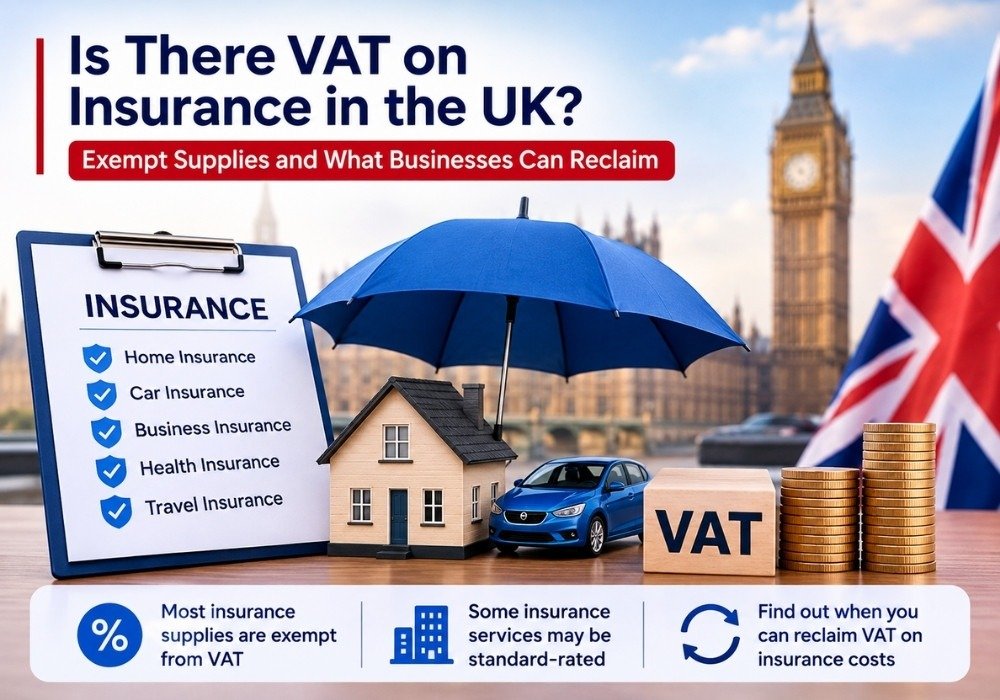
No. Insurance is exempt from VAT under Group 2 of Schedule 9 to the Value Added Tax Act 1994, so there is no VAT to charge on a premium and none to reclaim. The percentage you see added to a premium is Insurance Premium Tax, a separate charge under the Finance Act 1994, and it works nothing like VAT. This article explains why the two are different and what your business can and cannot recover.
VAT on insurance in the UK causes more confusion than almost any other line on a supplier invoice. A business owner sees a percentage added to a premium, assumes it must be VAT, and tries to reclaim it. The reclaim is wrong, the bookkeeping is wrong, and HM Revenue and Customs can assess the shortfall with interest. The confusion is understandable, because insurance sits outside the normal VAT rules and carries its own tax instead. This article sets out why insurance is exempt from VAT, what Insurance Premium Tax actually is, and how the two taxes affect what you can recover. It covers the position for ordinary businesses buying cover, for insurers and brokers making exempt supplies, and for landlords who recharge insurance to someone else. It does not cover the detailed partial exemption method that insurers use to split their input tax, which deserves its own treatment. By the end you will know exactly what to look for on a premium and how to record it correctly.
Key Takeaways
-
Insurance is exempt from VAT under Group 2 of Schedule 9 to the Value Added Tax Act 1994, which means it is not zero rated and not outside the scope of VAT.
-
The tax charged on most general insurance is Insurance Premium Tax under Part III of the Finance Act 1994, set at the standard rate of 12 percent.
-
A higher Insurance Premium Tax rate of 20 percent applies to travel cover and to certain insurance sold with goods, listed in Schedule 6A to the Finance Act 1994.
-
Insurance Premium Tax can never be reclaimed as input tax, which is the single biggest difference between it and VAT.
-
Life insurance, permanent health insurance and risks located outside the UK are exempt from Insurance Premium Tax under Schedule 7A to the Finance Act 1994.
-
Insurers and brokers usually cannot recover VAT on their costs, because their supplies are exempt, subject to partial exemption and the specified supplies rules.
-
A business can still reclaim VAT on repair or replacement costs paid under a claim, where the normal input tax rules are met.
Insurance Is an Exempt Supply for VAT
Insurance is treated as an exempt supply, which means no VAT is charged on the premium and the insurer cannot recover VAT on most of the costs it incurs to provide the cover. The statutory basis is Group 2 of Schedule 9 to the Value Added Tax Act 1994. Item 1 of that Group exempts insurance and reinsurance transactions, and Item 4 exempts the related services of brokers and agents who act as intermediaries. HM Revenue and Customs sets out the practical detail in Insurance (VAT Notice 701/36). The key point is that exempt is not the same as zero rated, because a zero rated supply still lets the supplier recover input tax while an exempt supply does not.
There is no single statutory definition of insurance, so the meaning comes from case law. The leading authority is Card Protection Plan Ltd (Case C-349/96), later applied in United Biscuits (Pension Trustees) Ltd (Case C-235/19). The test is that the insurer agrees, in return for a premium, to provide the insured with an agreed sum or service if a covered risk occurs. The exemption exists because a premium is a payment for accepting risk rather than for goods or services consumed in the ordinary way. Charging VAT on that kind of payment does not fit the way the tax is designed to work, so insurance was carved out and given its own tax instead.
Insurance Premium Tax and Its Two Rates
Insurance Premium Tax, usually shortened to IPT, is the tax that applies to insurance in place of VAT. Parliament introduced it in the Finance Act 1994, precisely because VAT could not be charged on insurance premiums. The standard rate is set by section 51 of the Finance Act 1994 and has stood at 12 percent since June 1, 2017. It applies to most general insurance, including motor, home, commercial property, public liability, professional indemnity and pet cover. The insurer charges IPT on the whole premium and accounts for it to HM Revenue and Customs.
A higher rate of 20 percent also exists, and it catches a narrower set of policies. Schedule 6A to the Finance Act 1994 sets out the higher rate categories, which include travel insurance and certain cover sold alongside goods such as mechanical or electrical appliances, and some motor arrangements made through dealers. The higher rate was introduced to stop businesses avoiding VAT by loading value into an insurance line sold with a product. A range of insurance is exempt from IPT altogether, listed in Schedule 7A to the Finance Act 1994. That list includes life insurance, permanent health insurance, reinsurance, commercial ships and aircraft, and risks located outside the UK.
Clearing the Confusion Between VAT and IPT
The confusion is easy to understand, because VAT and IPT look alike on paper. Both are consumption taxes, both appear as a percentage added to a price, and both are collected by the supplier and paid to HM Revenue and Customs. When a business sees 12 percent on a premium, it reaches for the VAT rules out of habit, because the figure sits close to the rates it handles every day. The two taxes sit in completely different places in the system though. VAT is charged on taxable supplies and can usually be recovered by a registered business, while IPT is charged on insurance premiums and can never be recovered.
The cleanest way to hold the difference in your head is to look at what each tax actually does. Insurance is an exempt supply under Group 2 of Schedule 9 to the Value Added Tax Act 1994, so it never carries VAT, which is why there is no VAT line to reclaim. Parliament created IPT in the Finance Act 1994 to raise revenue from insurance that VAT could not reach, so IPT fills the gap rather than sitting alongside VAT. That is why you will never see both taxes on the same premium. If the percentage relates to insurance, it is IPT, and it is a cost you carry rather than a tax you reclaim.
What a Business Can and Cannot Reclaim
The short answer is no, and the reason matters. Because insurance is exempt from VAT, there is no VAT on the premium in the first place, so there is nothing to enter in the input tax box of a VAT return. The percentage you see added to the premium is IPT, and IPT can never be recovered as input tax. It is a genuine cost that the policyholder absorbs, in the same way as any other overhead. This is the point that businesses get wrong most often.
The common error is to treat a gross premium as though it contained VAT at 20 percent and to reclaim one sixth of the total. That reclaim is not due, and HM Revenue and Customs can assess the amount wrongly recovered, together with interest and a possible penalty. The IPT itself is not wasted for tax purposes though. It forms part of the premium expense, so it is deductible against profits for income tax or corporation tax where the cover is wholly and exclusively for the business. So the tax reduces your profit, but it never reduces your VAT bill.
Input VAT Recovery for Insurers and Brokers
Insurers and brokers face the mirror image of the customer position. Because their main supplies are exempt, they generally cannot recover the VAT on the costs they incur to make those supplies. This is where partial exemption comes in. A business that makes both taxable and exempt supplies has to split its input tax between the two, recovering the taxable part and blocking the exempt part, subject to the de minimis limits in VAT Notice 706. For a pure insurer the exempt part is large, so a great deal of input tax is lost.
There is an important exception that improves recovery. The Value Added Tax (Input Tax) (Specified Supplies) Order 1999 allows input tax recovery on certain insurance supplied to customers who belong outside the UK, and on cover linked to the export of goods. The supply stays exempt, so no VAT is charged, but the related input tax becomes recoverable. Since the UK left the EU, this treatment now extends to customers based in the EU, which improved recovery for insurers and brokers with overseas books. Any insurer relying on this should keep clear evidence of where each customer belongs.
Reading a Premium Invoice Correctly
Reading a premium correctly saves a lot of trouble at the bookkeeping stage. Take commercial premises cover quoted at £2,000. The invoice shows £2,240, and the extra £240 is IPT at 12 percent, not VAT. There is no input tax to claim on any part of it. The full £2,240 is deductible against profits if the cover is for the trade, but it stays out of the VAT return entirely.
Broker charges need a second look, because a separately stated fee is not automatically exempt. Suppose a broker shows a premium of £2,240 plus an arrangement fee of £150. Where the broker only arranges the insurance as an intermediary, the fee is exempt as an insurance related service under Item 4 of Group 2. But where the insurance is sold in connection with the broker’s own taxable goods or services, Notes 3 to 5 of Group 2 and paragraph 11.3 of Notice 701/36 make the fee exempt only if both the premium and the fee are disclosed to the customer in writing at or before the time the insurance is entered into. Without that written disclosure the fee is taxable at the rate of the underlying goods or services. So the safe rule is this. The percentage on the premium itself is IPT and never recoverable VAT, but test any separate fee against the disclosure condition before you treat it as exempt.
Accounting for Insurance in a VAT Return
Insurance premiums do not belong in the VAT return in the way many people expect. Since the supply is exempt and carries no VAT, there is no input tax figure to enter in box 4, and the IPT is not a VAT item at all. Most businesses simply record the gross premium as a cost in their accounts and leave the VAT return untouched by it. The one place insurance can touch a VAT return is on the claims side rather than the premium side.
When a business suffers an insured loss and repairs or replacements are supplied to it, the normal input tax rules apply to those repair costs. A VAT registered business that can recover the VAT on a repair does so in the usual way, and the insurer then typically settles only the net amount. Where the insured cannot recover the VAT, the insurer settles the gross figure instead. This is exactly why claim forms ask whether you are registered for VAT, and getting the answer right keeps the settlement correct.
Insurance Recharged by a Landlord
Recharged insurance trips up a lot of businesses, and landlords most of all. Where the landlord holds the policy in its own name and the cover protects the landlord’s own risk, the recharge to the tenant is not a fresh supply of insurance, because the landlord is not an insurer. In that case the recharge follows the VAT liability of the rent, as HM Revenue and Customs explains in Insurance (VAT Notice 701/36) at paragraph 11.1. So if the rent is exempt the recharge is exempt too, and if the landlord has opted to tax the property the recharge follows the rent and carries VAT at the standard rate, even though the original premium only ever bore IPT.
The position is different where the policy names the tenant as the insured party and covers the tenant’s own risk. Paragraph 11.1 of the same notice treats that as an exempt supply of insurance passing through the landlord, and the premium may even qualify as a disbursement under paragraph 13.4 where the strict disbursement conditions are met. So the name on the policy and whose risk is covered decide the treatment, not the label on the invoice. A landlord who simply copies the insurer IPT onto the tenant invoice, and calls it insurance, is very likely getting the VAT treatment wrong. The safe step is to check who is insured first, then decide the liability of the rent where the landlord is the insured party, and apply the matching treatment to the recharge.
Two Situations That Show the Difference
Consider a cafe that receives an insurance renewal of £3,360. The base premium is £3,000 and the £360 shown on the invoice is IPT at 12 percent. Reading that line as VAT, the bookkeeper reclaims one sixth of the total, around £560, as input tax over the year. On review, HM Revenue and Customs disallows the claim, because there was never any VAT on an exempt premium under Group 2 of Schedule 9 to the Value Added Tax Act 1994. The business repays the input tax with interest, when a correct entry at the start would have avoided the whole problem.
Now take a commercial landlord who insures a let building in its own name and recharges the premium to the tenant. The landlord has opted to tax the property, so the rent carries VAT. Because the landlord is the insured party, the recharge follows the rent and carries VAT at the standard rate, even though the original premium only bore IPT. Treating the recharge as exempt insurance would understate the output VAT due and expose the landlord to an assessment. The answer would flip if the policy named the tenant as the insured, which shows why the name on the policy has to be checked before the recharge is coded, as set out in Insurance (VAT Notice 701/36).
Practical Steps to Take Now
Start by checking how insurance is coded in your own records. Pull a recent premium, find the percentage line, and confirm it has been treated as IPT and not as recoverable VAT. If you find premiums where a sixth of the cost has been reclaimed as input tax, correct the position before HM Revenue and Customs does, because a voluntary correction is always cheaper than an assessment. If you recharge insurance to a tenant or a customer, check whether the recharge should follow the VAT liability of the main supply rather than being passed on as exempt insurance, since this is where most landlords slip. If you run an insurance business or a brokerage, review your partial exemption calculation and confirm whether any of your customers belong outside the UK, because the specified supplies rules may unlock input tax you are currently writing off. Insurance tax looks simple on the surface and punishes small mistakes quietly over several returns. A short review now protects you from a long correction later. Where the position is unclear, or a recharge or partial exemption calculation is involved, speak to a qualified adviser before you file, so the treatment is right the first time.
Frequently Asked Questions
No. Insurance is exempt from VAT, so there is no VAT on the premium to reclaim. The percentage you see added is Insurance Premium Tax, and that can never be recovered as input tax. It is simply a cost of holding the cover.
No. Business insurance is exempt from VAT in the same way as personal insurance. Your commercial premium carries Insurance Premium Tax instead, usually at the standard rate of 12 percent, and that tax stays out of your VAT return.
That 12 percent is Insurance Premium Tax at the standard rate, not VAT. Your insurer collects it on the premium and pays it to HM Revenue and Customs. You cannot reclaim it, but it does count as part of your deductible insurance cost for income tax or corporation tax.
No. They are separate taxes with different rules. VAT can often be reclaimed by a registered business, while Insurance Premium Tax never can. The easiest way to remember it is that VAT is recoverable and IPT is a final cost.
This article is general information about UK insurance tax and is not a substitute for advice on your own circumstances.
