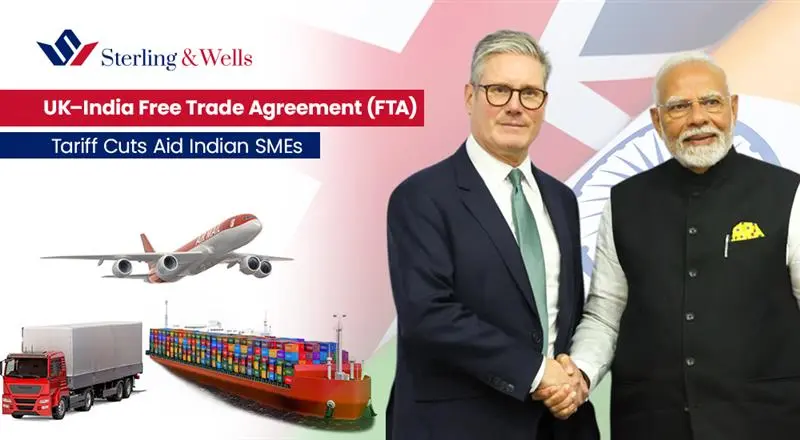
The UK–India free trade agreement, FTA, (signed May 2025) sharply cuts import duties on Indian goods entering Britain. In fact, the UK has agreed to eliminate tariffs on almost all Indian exports – about 99% of tariff lines become duty-free.
Key labour-intensive sectors for Indian SMEs – textiles/apparel, leather and footwear, gems & jewellery, furniture, toys, sports goods, etc. – now enter the UK at 0% duty. Previously these products typically faced tariffs ranging from roughly 2% up to 12–16% (and in some cases ~18%). The tariff cuts thus directly reduce export costs for small Indian businesses, boosting their margins.
Tariff changes
Under the deal, the UK removed tariffs on Indian-made clothing, footwear, leather goods, gems & jewelry, textiles and many consumer items. For example, UK duties on garments were up to ~12%, on some footwear ~16%, and on jewellery up to 4%; all these drops to 0% immediately. Overall, Indian exports to Britain will face almost no import tax.
SME impact
Small online exporters often ship modest-value goods with thin margins. Eliminating even a 5–15% tariff can be a significant saving. For instance, prior to the FTA a £1,000 shipment of T-shirts would incur £120 in duty (12%), but now that falls to £0 (saving £120). Such savings directly improve profitability for Indian SMEs.
Illustrative calculation
Suppose an Indian SME sells various goods to UK customers. The table below shows sample products before and after the tariff cuts:
| Product | Total value | Tariff (pre-FTA) | Tariff cost (pre-FTA) | Tariff (post-FTA) | Tariff cost (post-FTA) | Savings |
|---|---|---|---|---|---|---|
| Cotton T-shirt | £1,000 | 12% | £120 | 0% | £0 | £120 |
| Leather Shoes | £1,000 | 16% | £160 | 0% | £0 | £160 |
| Gemstone Bracelet | £1,000 | 4% | £40 | 0% | £0 | £40 |
Table: Tariff cost comparison for a £1,000 export shipment (pre- vs post-FTA). Rates are typical UK import duties on these items.
-
UK-India Affecting Textile & Apparel
Before the deal, UK applied ~12% duty on Indian-made apparel. On a £1,000 sale that meant £120 in customs tax. After FTA, the duty is 0%, saving the exporter £120.
-
UK-India Affecting Footwear(Shoes)
UK tariffs on leather footwear were about 16%. For a £1,000 shipment that was £160 in duty; now it drops to £0, saving £160.
-
UK-India Affecting Gems & Jewellery
UK duty on gems & jewellery was up to ~4%. A £1,000 bracelet shipment incurred £40 duty, now eliminated for a £40 saving.
These examples illustrate that duty-free access substantially cuts costs for Indian SMEs exporting consumer goods. In practice, an exporter paying £100–£200 in duties (common on £1,000–£2,000 shipments) now pays zero, directly boosting their margins. For small online businesses, this makes their products more price-competitive in the UK market, and the savings are often passed along as better pricing or higher profits.
