International students do not get a special exemption from UK tax simply because they are students. But you should not pay more tax than the law requires.
Depending on your circumstances, you may be able to reduce your tax bill by using your Personal Allowance, correcting the wrong PAYE tax code, reclaiming overpaid tax, claiming genuine employment expenses, using pension tax relief or protecting savings inside an ISA.
If you also receive income from abroad, tax treaties, split-year treatment and the four-year Foreign Income and Gains regime may become relevant.
The first step is simple: work out what tax you actually owe before looking for a tax-saving strategy.
A student earning £10,500 during the tax year, for example, may already have no Income Tax to pay if they are entitled to the full £12,570 Personal Allowance.
Key Takeaways
-
There is no separate student exemption from UK Income Tax
-
The standard Personal Allowance for 2026/27 is £12,570 for someone entitled to it
-
An incorrect PAYE code can result in too much tax being deducted
-
National Insurance is separate from Income Tax and can still be payable even when your annual income is below £12,570
-
Pension contributions can receive tax relief, while pension salary sacrifice may also reduce National Insurance where the conditions are met
-
If you're a student with a low income, you could earn more savings interest tax-free than you might expect. Depending on your earnings and eligibility, the £5,000 starting rate for savings could work alongside your unused Personal Allowance and Personal Savings Allowance, meaning you may not need an ISA just to avoid tax on your savings interest.
-
An ISA does not make your salary tax-free; it protects future savings and investment returns
-
If you have foreign income, check treaty relief and ordinary allowances before automatically claiming FIG relief
How Can Students Save Tax with Their Personal Allowance?
For 2026/27, the standard Personal Allowance is £12,570. This is the amount of income you can normally receive before paying Income Tax.
If you are UK tax resident, you will generally be entitled to the relevant personal allowances, subject to the normal rules.
The position can be different if you are not UK resident. A non-resident’s entitlement can depend on factors such as nationality or the terms of a double taxation agreement.
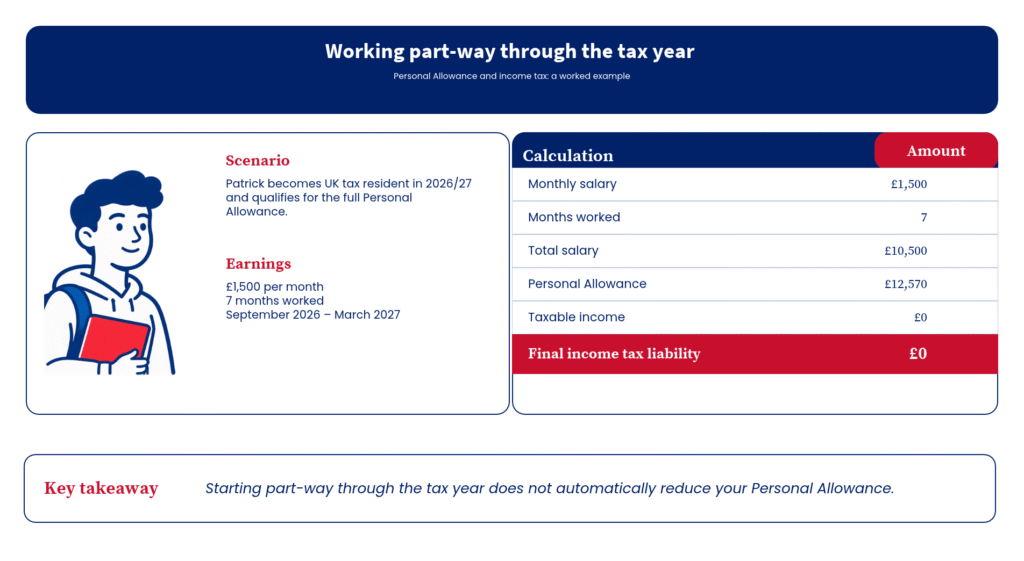
If you become UK resident during the tax year and split-year treatment applies, HMRC says the full annual allowances can still be available in the year of arrival, provided you are otherwise entitled to them.
So before looking for complicated tax planning, check whether your existing Personal Allowance already covers your income.
Why Do Students Still Pay National Insurance if They Pay No Income Tax?
You might be wondering why National Insurance is being deducted from your salary when you don’t have to pay any Income Tax.
The reason is simple: Income Tax and National Insurance are calculated differently.
While Income Tax depends on your taxable income and Personal Allowance, National Insurance is normally calculated based on how much you earn each pay period.
For the 2026/27 tax year, most employees pay 8% National Insurance on monthly earnings between £1,048 and £4,189.
Let’s take Patrick as an example. He earns £1,500 a month while studying in the UK.
| Calculation | Amount |
|---|---|
| Monthly salary | £1,500.00 |
| Monthly NI threshold | £1,048.00 |
| Earnings above the threshold | £452.00 |
| National Insurance at 8% | £36.16 |
| Income Tax | £0 |
| Monthly take-home pay | £1,463.84 |
This example assumes Patrick has no Income Tax or other payroll deductions and pays the standard employee National Insurance rate.
Even though Patrick’s total annual salary is below the £12,570 Personal Allowance, he still pays £36.16 in National Insurance each month he earns £1,500.
Note
If you’re an international student working in the UK, earning less than £12,570 a year doesn’t automatically mean you’ll have no deductions from your salary.
Your Personal Allowance can cover your Income Tax, but National Insurance follows its own rules.
How Can Students Get Back Overpaid PAYE Tax?
Have you ever checked your payslip and wondered why Income Tax has been deducted when you haven’t earned much? If you’re an international student working in the UK, there’s a chance you could be paying more tax than you need to.
In the UK, employers deduct Income Tax from your salary through a system called Pay As You Earn (PAYE). It’s simply how HMRC collects Income Tax from your wages.
Why Might You Be Paying Too Much Tax?
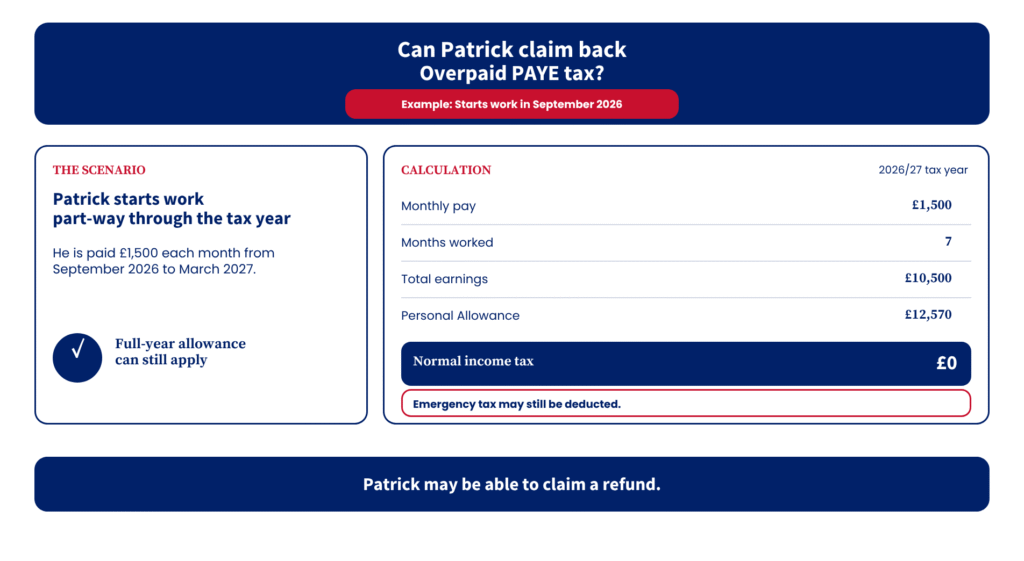
When you start a new job, your employer might not have all the information about your previous earnings. This means they may initially put you on an emergency tax code.
Emergency tax codes often end in W1, M1 or X, such as 1257L M1. Instead of looking at your earnings across the tax year, these codes calculate tax based on your current pay period. As a result, you could end up paying more Income Tax than you actually owe.
How Can You Check and Claim a PAYE Tax Refund?
If you think you’ve paid too much Income Tax, here are a few things worth checking:
-
Your payslip
Look at your tax code and how much Income Tax has been deducted.
-
Your HMRC Personal Tax Account
Check whether HMRC has the correct details about your income and employment.
-
Your P45
If you've left a job, this shows how much you earned and how much tax you paid before leaving.
If you’re still working, getting your tax code corrected may mean your employer can refund the extra tax through your wages.
If you’ve stopped working, you may be able to claim a refund directly from HMRC. For example, if you’ve left your job and returned to full-time studies, you might qualify to claim using form P50, depending on your circumstances.
Note
Seeing Income Tax deducted from your payslip doesn’t always mean you actually owe that amount. It’s worth checking your tax code and earnings, as you could be entitled to a refund.
Which Work Expenses Can Students Claim Tax Relief On?
If you’re studying and working part-time in the UK, you may sometimes have to spend your own money on things you need for your job. The good news is that some of these costs could qualify for tax relief.
HMRC allows employees to claim tax relief on certain work-related expenses, provided they meet the rules and haven’t been fully reimbursed by their employer.
What Work Expenses Can You Claim?
Depending on the type of work you do, you may be able to claim tax relief for:
-
Uniforms and work clothing
The cost of cleaning, repairing or replacing qualifying uniforms or specialist clothing.
-
Tools and equipment
Certain tools or equipment you need to do your job.
-
Professional subscriptions
Membership fees paid to professional organisations approved by HMRC.
-
Business travel
Travel for work-related purposes, excluding your normal journey between home and your regular workplace.
But remember, just because you buy something for work doesn’t automatically mean you can claim tax relief on it.
For example, suppose you work part-time at a restaurant, and your employer asks you to wear black trousers. Even though you bought them specifically for work, HMRC would normally consider them everyday clothing, so you wouldn’t be able to claim tax relief.
Note
- Another thing to keep in mind is that tax relief doesn’t mean getting all your money back. It simply reduces the amount of Income Tax you have to pay.
- If your earnings are already below your Personal Allowance and you don’t owe any Income Tax, claiming these expenses generally won’t give you an additional tax refund.
What if You Work from Home?
If you work remotely alongside your studies, there’s an important change you should know about.
From 6 April 2026, employees can no longer claim Income Tax relief for additional household costs they pay themselves while working from home, such as extra electricity or heating expenses.
However, this doesn’t mean your employer can’t help with these costs. If the relevant conditions are met, your employer may still be able to reimburse qualifying homeworking expenses without Income Tax or National Insurance being charged.
The key takeaway?
If you’re spending your own money on things, you need for work, it’s worth checking whether you can claim tax relief. Not every expense will qualify, but knowing what HMRC allows could help you avoid paying more Income Tax than necessary.
How Can Students Save Tax Through Pension Contributions?
If you’re working while studying in the UK, saving for retirement might not be your first priority. But if you’re contributing to a pension, you could be missing out on valuable tax benefits.
The UK government offers tax relief on qualifying pension contributions, which means more money can go into your pension than you actually pay yourself.
How Does Pension Tax Relief Work?
One common way to receive pension tax relief is through a system called relief at source.
With this arrangement, you pay money into your pension, and your pension provider claims basic-rate tax relief from HMRC and adds it to your pension savings.
For example:
| Pension contribution | Amount |
|---|---|
| You contribute | £80 |
| Your pension provider claims from HMRC | £20 |
| Total added to your pension | £100 |
So, for every £80 you contribute, £100 goes into your pension.
And here’s something worth knowing: you may still qualify for this tax relief even if you don’t pay Income Tax.
Under HMRC rules, eligible individuals with no earnings can generally contribute up to £2,880 a year into a relief-at-source pension and receive £720 in tax relief, bringing the total to £3,600.
If you’re earning money, the amount eligible for tax relief will depend on your relevant UK earnings and other pension rules.
The standard pension annual allowance for 2026/27 is £60,000, although your personal tax-relievable contribution limit may be lower.
Note
However, remember that pension savings are meant for retirement. If you’re studying in the UK and might need money for rent, tuition fees or living expenses, it’s important to consider whether you can afford to put that money away.
Can Pension Salary Sacrifice Help You Save National Insurance?
If your employer offers pension salary sacrifice, you may also be able to reduce your National Insurance contributions.
But how does it work?
Instead of receiving your full salary, you agree to give up part of your future pay. Your employer then contributes that amount directly into your pension.
Because your cash salary is lower, the National Insurance deducted from it may also be lower.
Let’s look at Patrick’s example again.
Patrick earns £1,500 per month. Suppose his employer offers salary sacrifice and he agrees to put £200 of his monthly salary into his pension.
Here’s how his position could change:
| Calculation | Without salary sacrifice | With salary sacrifice |
|---|---|---|
| Monthly salary | £1,500 | £1,500 |
| Amount put into pension through salary sacrifice | £0 | £200 |
| Salary after sacrifice | £1,500 | £1,300 |
| National Insurance deducted | £36.16 | £20.16 |
| Cash received after NI | £1,463.84 | £1,279.84 |
| Monthly NI saved | £0 | £16 |
This example assumes Patrick has no Income Tax or other payroll deductions, pays the standard employee NI rate and is eligible for the arrangement.
By putting £200 of his salary into his pension through salary sacrifice, Patrick reduces his monthly National Insurance from £36.16 to £20.16, saving £16 each month.
However, this doesn’t mean he receives an extra £200 in cash. Instead, that money goes into his pension, while his take-home pay falls by £184 rather than the full £200.
Remember: Salary sacrifice isn’t available to everyone. Your employer must offer it, and your remaining pay must not fall below the National Minimum Wage. Whether Patrick can use this arrangement depends on his age and working hours.
Can everyone use salary sacrifice?
Not necessarily. Your employer must offer the arrangement, and your remaining salary cannot fall below the National Minimum Wage.
For students working part-time, this is particularly important, as eligibility depends on factors such as age, working hours and hourly pay.
Salary sacrifice can also affect certain benefits and statutory payments, so it’s worth checking the details before agreeing to it.
The key takeaway?
Pension contributions can help you save tax, while salary sacrifice may also reduce your National Insurance. But if you’re studying in the UK, make sure you can comfortably cover your everyday expenses before putting money into a pension.
How Much Savings Interest Can Students Earn Tax-Free in the UK?
If you’re studying in the UK and have some money in a savings account, you might be wondering whether you’ll need to pay tax on the interest you earn.
The good news is that you could earn more than £1,000 in savings interest without paying any UK Income Tax.
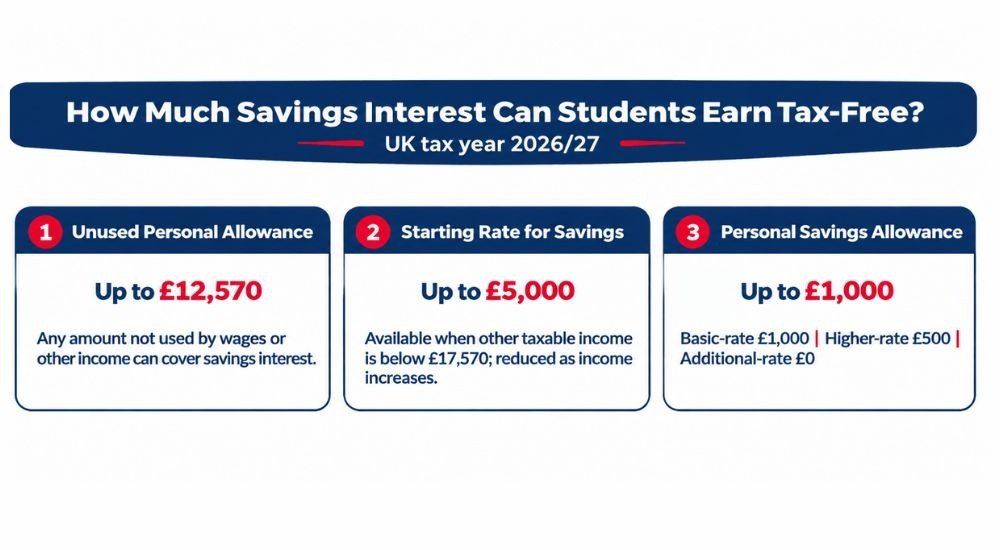
For the 2026/27 tax year, HMRC provides three allowances that can help reduce your tax on savings interest: the Personal Allowance, the starting rate for savings and the Personal Savings Allowance.
How much you can earn tax-free depends on your other income and which allowances you’re entitled to.
Here’s how these allowances work:
Worked Example: How Much Savings Interest Could You Earn Tax-Free?
Let’s say you’re a student earning £10,500 a year from part-time work, with no other taxable income.
Assuming you’re entitled to the full Personal Allowance, here’s how much savings interest you could receive tax-free:
| Allowance | Amount |
|---|---|
| Unused Personal Allowance (£12,570 − £10,500) | £2,070 |
| Starting rate for savings | £5,000 |
| Personal Savings Allowance | £1,000 |
| Total tax-free savings interest | £8,070 |
In this example, you could earn up to £8,070 in savings interest without paying UK Income Tax.
The Key Takeaway
If you’re studying and working part-time, you might be able to earn more savings interest tax-free than you realise.
Before opening an ISA purely to save tax, it’s worth checking whether your existing allowances already cover the interest you’re earning.
Remember, these allowances aren’t just for students. Your entitlement depends on your income and individual circumstances, including whether you qualify for the UK Personal Allowance.
How Can Students Save Tax with an ISA in the UK?
If you’re studying and working in the UK, an Individual Savings Account (ISA) can help you grow your savings without paying UK tax on the interest or investment returns.
For 2026/27, you can put up to £20,000 across your ISAs, provided you’re eligible. You generally need to be at least 18 and UK resident to open an adult ISA.
How Does an ISA Save You Tax?
Suppose you save £5,000 in a Cash ISA earning 4% annual interest.
| Calculation | Amount |
|---|---|
| Money saved | £5,000 |
| Annual interest rate | 4% |
| Interest earned in one year | £200 |
| Tax on ISA interest | £0 |
You keep the full £200 interest without paying UK Income Tax on it.
However, an ISA doesn’t make your salary tax-free. You still pay any Income Tax and National Insurance due on your earnings before putting money into the account.
Also, if your savings interest is already covered by your Personal Savings Allowance, you may not save any extra tax by using an ISA.
Can International Students Save Tax Through Double Taxation Agreements?
If you’re an international student in the UK, it’s worth checking whether your home country has a tax agreement with the UK. You might be entitled to tax relief without even realising it.
The UK has double taxation agreements (DTAs) with many countries, and some include special tax benefits for international students.
For example, if your family sends you money from abroad to help with living costs, tuition fees or other study expenses, those payments may qualify for a UK tax exemption under the relevant agreement.
Some agreements may also offer tax relief on money you earn from part-time work in the UK, although certain conditions and limits apply.
The key takeaway?
Tax treaty benefits aren’t the same for everyone. What you can claim depends on your home country’s agreement with the UK and your circumstances, so it’s always worth checking which rules apply to you.
Can International Students Save Tax with FIG Relief?
If you’re an international student earning income from abroad, you may qualify for tax relief under the four-year Foreign Income and Gains (FIG) regime.
This relief can exempt certain foreign income and gains from UK tax. However, you must generally have been non-UK resident for at least 10 consecutive tax years before becoming UK resident.
FIG relief is available for up to your first four tax years of UK residence and must be claimed through Self-Assessment.
But there’s a catch: Claiming FIG relief means losing your £12,570 Personal Allowance for that tax year.
Is FIG Relief Always Worth Claiming?
Example: Suppose an eligible international student earns £10,500 from a UK job and receives £600 in foreign bank interest during 2026/27.
| Calculation | Without FIG Claim | With FIG Claim |
|---|---|---|
| UK employment income | £10,500 | £10,500 |
| Foreign bank interest | £600 | £600 |
| Less: FIG relief claimed | £0 | (£600) |
| Income after FIG relief | £11,100 | £10,500 |
| Less: Personal Allowance | (£11,100) | £0 |
| Taxable income | £0 | £10,500 |
| Income Tax at 20% | £0 | £2,100 |
| Total Income Tax payable | £0 | £2,100 |
Assumes the student qualifies for FIG relief, has no other income or tax reliefs, and is entitled to the £12,570 Personal Allowance without making a FIG claim. The example uses the basic Income Tax rate applicable in England, Wales and Northern Ireland. National Insurance is excluded.
Why is there a £2,100 difference?
Without FIG relief: The student’s total income is £11,100, which is below the £12,570 Personal Allowance. Therefore, no Income Tax is payable.
With FIG relief: The £600 foreign interest is exempt from UK tax, but the student loses their Personal Allowance. This means their £10,500 UK salary becomes taxable at 20%, resulting in £2,100 Income Tax.
The key takeaway
Claiming FIG relief in this example would increase the student’s tax bill by £2,100 instead of saving tax.
Can International Students Save Tax with Split-Year Treatment?
If you move to or leave the UK partway through a tax year, split-year treatment could help you avoid paying UK tax on certain overseas income.
If you meet HMRC’s conditions, your tax year is divided into two parts:
-
Overseas part
Most foreign income and gains are generally outside UK tax.
-
UK part
Your UK income and potentially your foreign income are subject to UK tax.
Example: Patrick Moves to the UK in September
Patrick works in India before moving to the UK on 1 September 2026 to begin university.
Assuming he qualifies for split-year treatment from that date:
| Period | Income | UK tax treatment |
|---|---|---|
| April–August 2026 | £8,000 earned in India | Generally, not taxable in the UK |
| September 2026–March 2027 | £10,500 earned in the UK | Subject to UK tax rules |
Patrick’s £8,000 Indian salary would generally fall outside UK tax. His £10,500 UK salary would also be covered by his £12,570 Personal Allowance, assuming he qualifies for the full allowance and has no other taxable income.
What Are HMRC's Eight Split-Year Cases?
HMRC has eight specific cases that determine whether split-year treatment applies.
| Case | Circumstances |
|---|---|
| 1 | Starting full-time work overseas |
| 2 | Accompanying a partner who starts full-time work overseas |
| 3 | No longer having a home in the UK |
| 4 | Starting to have a home only in the UK |
| 5 | Starting full-time work in the UK |
| 6 | Stopping full-time work overseas |
| 7 | Accompanying a partner who stops full-time work overseas |
| 8 | Starting to have a home in the UK |
Cases 1–3 generally relate to leaving the UK, while Cases 4–8 relate to arriving in the UK.
The key takeaway
Split-year treatment can help prevent certain overseas income from being taxed in the UK but simply moving to or from the UK doesn’t automatically qualify you. You must meet the specific conditions of at least one of HMRC’s eight cases.
Frequently Asked Questions
You are generally a UK tax resident if you spend 183 days or more in the UK during a tax year. You may also qualify with fewer days under HMRC’s Statutory Residence Test.
Yes, if your student visa permits full-time work during official holidays. Most eligible degree-level students are limited to 20 hours per week during term time.
From 1 April 2026, minimum hourly wages are £12.71 for ages 21+, £10.85 for ages 18–20 and £8.00 for eligible workers under 18. Different rates may apply to apprentices.
Yes, provided their visa allows employment. Most eligible degree-level students can work up to 20 hours per week during term time, but self-employment is generally prohibited.
The government has announced a minimum wage increase from April 2027, with hourly pay rising to £13.21 for workers aged 21 and over. Other changes include higher Student visa financial requirements and shorter Graduate visas from January 2027 for most non-doctoral graduates.
